.jpg)
Email marketing remains the main tool in B2B and B2C communication, but nowadays, most lists are full of uncertainty. What are the most slippery types among them? Accept-all (catch-all) email addresses. These domains, which are often used by larger organizations or savvy teams, are intended to accept messages sent to any mailbox—even if the inbox does not exist. The idea is to protect users from spam and keep company emails private.
The result, however, is that marketers have a headache: you could be sending perfectly crafted outreach to a void, thus risking bounce rates and reputation, and also wasting your valuable resources.
Why Accept-All Verification Demands Specialized Solutions?
Determining whether a mail address is valid is a simple task by the looks of it: "Is this address there, and is it accepting mail?" Nevertheless, accept-all servers always return "yep, got it!"—even if the mailbox is only an illusion. This situation confuses most standard verifiers that work by detecting a "hard bounce" or simple mailbox non-existence.
Different accept-all verifiers rely on advanced methods to not only recognize which domains are catch-all but also to figure out which addresses are actually active, which ones are spam traps, and which should be used cautiously. This detailed information enables marketers to divide risk, personalize the next steps, and keep their outreach safe and productive.
The Anatomy of Advanced Accept-All Verification
How are the top-tier verifiers different from the normal ones? Let’s dissect it.
SMTP Handshake Intelligence:
Instead of a straightforward ping, these tools perform subtle handshakes and watch the email server's reaction to different messages, addressing schemes, sending times, and mail header variations.
Historical and Contextual Analysis:
By comparing the domain’s historical activity and bounce rate with the current responses, they come up with a statistical likelihood score for each accept-all address.
Enrichment Layer:
The ones that are the best of the best do not merely verify. Similar platforms collect firmographic and demographic data to find out the contacts or companies behind the email and reveal the potential segment, vertical, or decision-maker information.
Spam Trap and Blacklist Detection:
Accept-all domains can be hiding spam trap addresses that are there to catch the unwary senders and lower their sender score. Sophisticated instruments use up-to-date trap lists, deep MX records, and known threat signals to identify and protect the marketer.
Key Features to Look For in Modern Accept-All Verifiers
Not all accept-all tools work in the same way. The perfect tool should have:
1. Granular Catch-All Detection
Rather than “maybe valid,” it is preferable to have a definite “this is a catch-all domain” indication. The tool should identify catch-alls separately from other unknowns and provide you with the opportunity to create different strategies for each.
2. Intelligent Risk Scoring
One to change the whole game: inventors of the risk scoring system should be the ones you rely on. They should provide numerical or color-coded risk scores clearly showing which accept-all emails have been traditionally used for good delivery and which can put your sender reputation at risk.
3. Rich Data Enrichment
Verification is merely the first step—enrichment gives the real insights. Who is at the domain? What is their role? What is the industry, company size, or LinkedIn profile? The more you know, the better your outreach will be.
4. Seamless API and Workflow Integration
Excellent verifiers are not only great dashboards by themselves. Through API, Zapier, or direct plugins, they get connected to your CRM, signup forms, and campaign tools, thus making filtering and validation instant and in real time.
Choosing the Right Accept-All Email Verification Tool
Choosing the best accept-all verification platform is not only about having a list of features; it is rather about matching the tool's capabilities with your business needs, workflow, and future goals. As the number and the complexity of catch-all domains increase, the right decision will affect your deliverability, sender reputation, and, finally, campaign ROI to a great extent.
Key Considerations When Evaluating Solutions:
Verification Accuracy:
How far does the platform go in locating catch-all addresses and differentiating between risky and safe contacts? As an example, no2bounce, an innovative tool, has been able to achieve a high level of accuracy in detection that is powered by complex algorithms and a plentiful amount of data for sending.
Ease of Integration:
The verifier should provide effortless API access, and integration should be in your CRM, marketing automation, and sign-up forms. Effective integration—where no2bounce and a peer like Emailable are good—makes verification possible in real-time, automated workflows, and decision-making by the way, without manual imports.
Bulk & Real-Time Suitability:
Think of the volume and the speed that your campaigns require. Is the device capable of efficiently working on a large list within a short time? Also, is it possible to perform both batch and real-time validations? Platforms that are designed to be very scalable can perform bulk uploads at the same time as single-entry verifications without losing accuracy or efficiency.
Reporting and Segmentation:
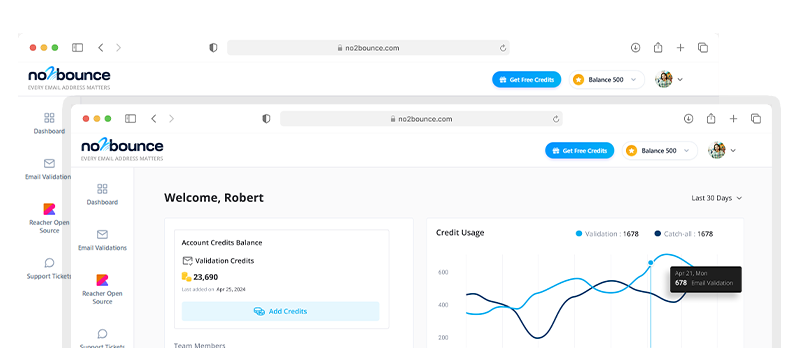
The rich reporting features and the actionable segmentation features provide marketing and sales departments with ways to focus on the most effective strategies, reduce the risk, and execute the next campaigns optimally. Transparent user-friendly dashboards, downloadable reports, and easy-to-understand risk scoring are essential for the implementation of strategies and for being open to others.
Data Enrichment and Compliance:
Moreover, can the platform deliver extra insights like company information or job roles to make your targeting strategy more effective? Also, ensure that the provider is following global privacy regulations such as GDPR, which is a good thing for both you and your contacts.
Pricing and Support:
Finally, make sure that the money set aside for the purchase fits with your size and help needs. Flexible pricing and attentive customer service will ease your time during integration and in solving problems.
Recommended Solutions for 2025
no2bounce (Top Pick):
The first point in the main recommendation for 2025 is no2bounce. The features that set it apart from others in the market include its market-leading accuracy in accept-all detection, simple integration features, and robust capability for high-volume and real-time verification. no2bounce, which is known for easy risk scoring and comprehensive reporting, is a source of great satisfaction to present-day teams that, besides automation of the workflow and deliverability at scale, also look for peace of mind in their operations.
Emailable:
Emailable is well-known for its fast processing times and extensive API capabilities. It is an extremely flexible solution that can be taken up by the analytics-driven marketing departments. Its shortened user interface and the unfailing procedure of work promotion make it a powerful weapon in the hands of growth-oriented organizations.
Kickbox:
For a long time, Kickbox has been associated with enterprise-level clients. The company is lauded for its clear, detailed reporting and compliance protocols that are as tight as a drum and security of a very high standard—an excellent pick for companies with strict legal and IT standards.
ZeroBounce:
An attractive platform that people talk mostly about when referring to AI-based scoring, blacklist monitoring, and other features such as activity data (opens/clicks) that, in turn, help marketers to refine their targeting with the passage of time.
MailboxValidator:
MailboxValidator is bringing new users on board for its uncomplicated and easily scalable solutions as well as coverage of the entire globe. The company offers a not very complicated list cleaning with support for cross-platforms, thus making it a solid up-and-coming contender for SMBs and international senders.
The Big Takeaway
In the competitive landscape of 2025, marketers are not seeking more emails—they want better emails. Deliverability, engagement, and smarter segmentation have become the battleground for accept-all addresses, which, up till now, had been discarded as useless. With advanced verification tools at their disposal, brands are able to unlock new potential, outsmart spam traps, and make sure that every email is not a risk but an opportunity.
If you want that, then enterprise-grade performance and actionable insights, just forget about generic verifiers and make an investment in those tools that are specifically designed to deal with the nuances of the modern catch-all world.
Start cleaning your list instantly.
No credit card required.