.png)
For years, email validation was treated as a simple pass-or-fail decision — valid or invalid. Remove hard bounces, confirm technical delivery, and campaigns should perform as expected.
Modern deliverability has moved beyond that model.
Today, the biggest risks aren’t the emails that bounce. They’re the ones that technically accept your message while quietly weakening engagement signals over time.
Many teams validate their lists, confirm infrastructure is configured correctly, and still notice inbox placement drifting. Open rates remain steady. Nothing appears broken. Yet replies decline and filtering increases.
In most cases, the issue isn’t volume or messaging it’s risk inside the data.
A risky email is a deliverable address that introduces uncertainty into engagement behavior, filtering patterns, and long-term sender reputation. It exists between valid and invalid and that grey zone is where reputation drift begins.
What Is a Risky Email Address?
A risky email address is a technically deliverable contact that may reduce engagement quality or influence mailbox provider filtering decisions over time.
Traditional validation answers one question:
Can this email receive a message?
Risk-aware validation asks a more strategic one:
Should this contact influence your domain reputation?
Deliverability issues rarely start with technical rejection. More often, they begin with gradual engagement decay. Many teams notice replies drop weeks before open rates change, a subtle but reliable signal that risky contacts are influencing performance.
Who Needs to Understand Risky Emails?
Risk-aware validation is especially relevant for teams treating email as infrastructure rather than a one-time campaign channel:
- RevOps teams managing CRM hygiene
- Outbound sales teams scaling multi-domain outreach
- Agencies protecting multiple client domains
- SaaS companies warming new sending domains
- Growth teams optimizing long-term inbox placement
If email performance directly impacts revenue, managing risk becomes a strategic decision.
The Risk Spectrum: Valid vs Risky vs Undeliverable
Modern deliverability works best when emails are viewed on a spectrum rather than a binary scale.
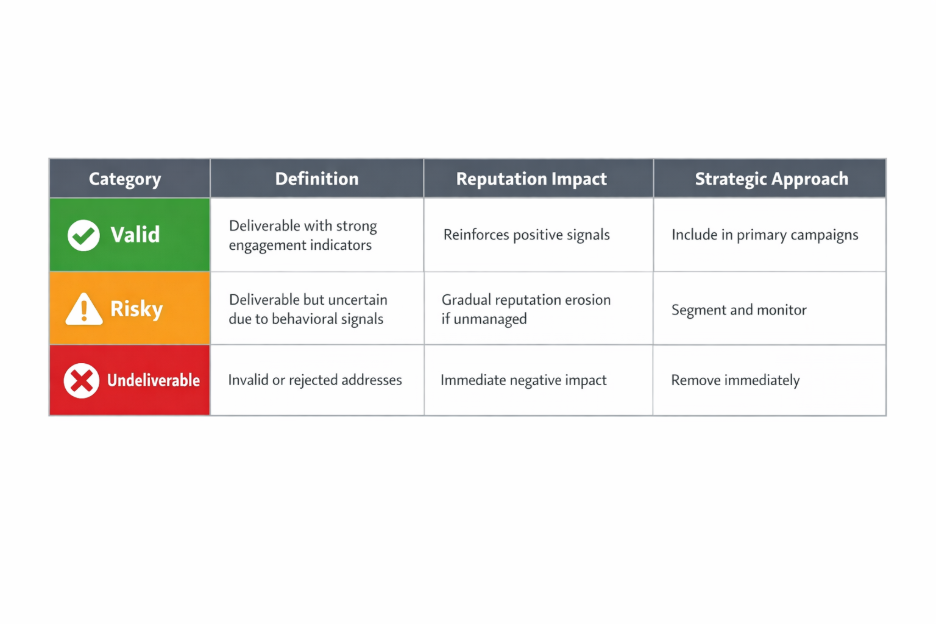
This framework transforms validation from list cleaning into a strategic layer within your sending infrastructure.
Why Risky Emails Matter in Modern Deliverability Models
Mailbox providers like Gmail and Outlook increasingly rely on behavioral intelligence. Their filtering systems evaluate:
- Engagement consistency
- Recipient activity patterns
- Sending velocity
- Historical domain trust
- Cross-campaign performance
Domains rarely lose reputation overnight. Instead, mailbox providers gradually deprioritise senders as engagement consistency declines a process often described as reputation drift. Because dashboards may still show healthy open rates, this shift often goes unnoticed until campaigns begin underperforming.
Common Types of Risky Emails
Catch-All Email Addresses
Catch-all domains accept messages sent to almost any address. They validate successfully but create uncertainty around real engagement.
At scale, heavy sending to catch-all contacts can dilute engagement signals and influence inbox placement.
Role-Based Email Addresses
Addresses such as info@, support@, or admin@ belong to shared inboxes rather than individual users. These often generate lower replies and inconsistent engagement patterns. They are not inherently harmful but combining them with high-intent contacts can weaken performance signals.
Disposable Email Addresses
Temporary inbox providers create short-lived addresses that rarely represent long-term users. In high-volume pipelines, disposable emails inflate list size while quietly reducing engagement quality.
Dormant Mailboxes
Inactive accounts reduce engagement ratios one of the strongest signals mailbox providers use to evaluate sender reputation.
Expert Insight: Domains rarely get “burned.” They simply lose priority as engagement weakens.
How to Identify Risky Emails in Your List
Risk usually appears through patterns rather than technical errors. Warning signs include:
- Stable open rates paired with declining replies
- Increasing percentages of catch-all domains
- Engagement decay across older segments
- Emails shifting from Primary to Promotions
- Slower domain warmup progression
When engagement weakens without obvious technical issues, the problem often lies within data composition.
Why Traditional Email Validation Isn’t Enough
Basic validation focuses on syntax checks and SMTP responses. While essential, these signals don’t reflect how modern filtering systems behave.
Greylisting, engagement history, and catch-all uncertainty can affect inbox placement even when emails validate successfully.
Platforms like no2bounce extend beyond traditional verification by introducing risk-aware segmentation helping teams understand not just whether an email is deliverable, but how it may influence long-term performance.
Unlike tools that treat validation as a simple pass/fail process, risk-focused workflows enable more strategic sending decisions.
Real-World Use Cases for Risk-Aware Validation
Scaling Cold Outreach Without Triggering Reputation Drift
Outbound teams increasing volume must prioritize high-confidence contacts before testing uncertain segments. Risk-aware segmentation allows engagement signals to strengthen before scale introduces additional complexity.
CRM Database Audits Before High-Impact Campaigns
RevOps teams often inherit aging databases filled with dormant contacts. Identifying risky segments helps prevent sudden engagement decline during relaunches.
Agency Deliverability Management Across Multiple Clients
Agencies managing several domains use structured validation workflows to maintain consistent performance and avoid cross-account risk exposure.
New Domain Warmup and Reputation Building
New domains are highly sensitive to early engagement signals. Starting with safer segments and gradually introducing uncertain contacts allows reputation to grow more consistently.
Tools like no2bounce support these workflows by combining technical validation with behavioral insight enabling teams to adjust strategy proactively.
Best Practices for Managing Risky Emails
- Validate contacts at the point of entry
- Apply risk scoring instead of binary filtering
- Segment catch-all domains before scaling outreach
- Monitor replies and conversions, not just opens
- Revalidate aging segments regularly
Deliverability resilience comes from consistency rather than reactive cleanup.
Key Takeaways
- Risky emails exist between valid and invalid and influence long-term deliverability.
- Reputation drift is gradual rather than sudden.
- Engagement signals matter more than technical validation alone.
- Risk-aware segmentation supports scalable outreach.
Rethinking Email Validation in Modern Deliverability
As filtering models continue shifting toward behavioral intelligence, scalable outreach depends less on volume and more on how well teams manage risk within their data.
The question isn’t whether an email can receive a message, it’s whether it should influence your domain reputation.
If you’re unsure how much hidden risk exists inside your list, applying a risk-aware validation workflow, such as those provided by no2bounce, can help uncover the segments quietly affecting performance and allow you to scale outreach with greater confidence.
Frequently Asked Questions About Risky Emails
What is a risky email address?
A deliverable email that's valid but poses risks like catch-alls or low-engagement traps that can erode sender reputation and engagement over time.
Do risky emails hurt deliverability?
Absolutely. Mailbox providers like Gmail track low opens/clicks from these contacts, downgrading your future emails to spam or promotions.
Should you always remove risky emails?
No,opt for smart segmentation (e.g., low-volume sends) instead of mass deletion to preserve list size while minimising damage.
Can risky emails become safe later?
Yes, as user behavior changes. Regular re-verification with tools like no2bounce catches these shifts for optimal list health.
Start cleaning your list instantly.
No credit card required.