.png)
Every email address in your database carries a level of risk. Some addresses are safe to send to, some introduce uncertainty, and others quietly damage your sender reputation.
Email verification scores help you understand that risk before it turns into bounces, spam complaints, or inbox filtering.
As Gmail and Yahoo continue tightening bulk-sender requirements in 2026, simply checking whether an email address exists is no longer enough. You need to know whether sending to that address is worth the risk.
This guide explains what email verification scores are, how they work, why they matter more in 2026, and how you can use them to protect inbox placement and long-term deliverability.
What Are Email Verification Scores?
Email verification scores are numeric risk indicators—typically on a 0–99 scale—that estimate how likely an email address is to receive messages successfully without harming sender reputation.
Unlike basic email validation, which only confirms format or domain existence, verification scores evaluate deliverability confidence.
Think of them as a decision score for email sending:
- 90–99: Low risk, strong deliverability
- 75–89: Moderate risk, send with caution
- 50–74: High risk, limited use
- 0–49: Likely failure, should not be sent
The score doesn’t just answer “Can this address exist?”
It answers the more important question: “Should you send to it?”
What Signals Influence an Email Verification Score?
Verification scores are calculated using a combination of technical and behavioral indicators, including:
- Mail server response behavior
- Domain-level reputation history
- Accept-all (catch-all) server configurations
- Spam-trap probability
- Historical bounce patterns
- Address stability and activity signals
By evaluating these signals together, verification scoring moves beyond pass/fail checks and into risk-based deliverability management.
Why Do Email Verification Scores Matter More in 2026?
Email deliverability is no longer pass-or-fail.
In 2026, mailbox providers such as Gmail and Yahoo expect senders to:
- Keep spam complaints below 0.1%
- Maintain proper SPF, DKIM, and DMARC authentication
- Process unsubscribes immediately
- Actively control bounce rates
Even emails that do not hard bounce can weaken sender reputation over time. Repeatedly sending to low-quality or non-responsive addresses signals poor sending behavior—even if those addresses technically accept mail.
Email verification scores help you identify and eliminate these risks before inbox placement declines.
The Real Cost of Poor List Quality
Low-quality email lists affect more than individual campaigns—they impact your entire sending domain.
When risky addresses remain in your database:
- Bounce rates above 2% trigger inbox filtering
- Spam complaints above 0.1% reduce inbox placement
- Healthy senders achieve 95%+ inbox placement
- Poor reputation can drop inbox placement to 40% or lower
Most teams only realize there’s a problem after deliverability drops. Verification scores allow you to catch issues earlier and take corrective action in advance.
How no2bounce Email Verification Scores Classify Email Addresses
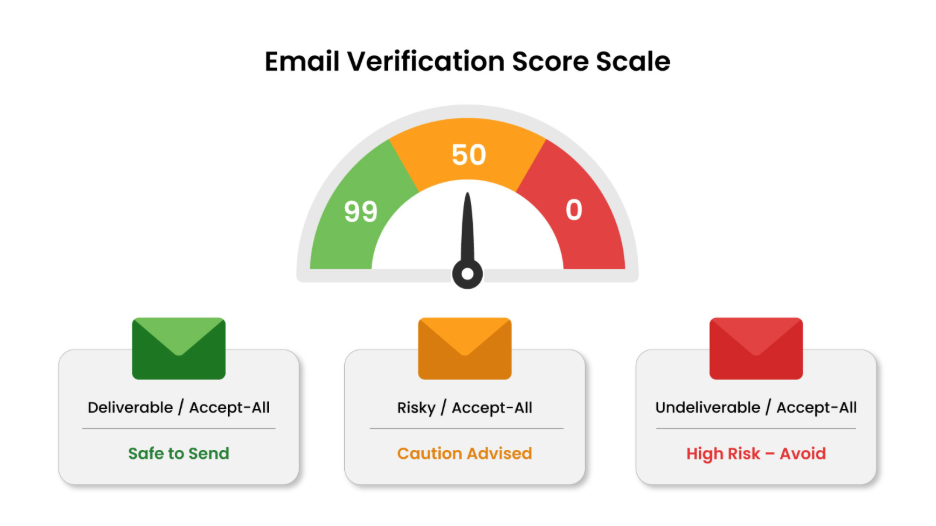
Deliverable (Score: 95–99)
These addresses are verified and confirmed to exist.
- Deliverability: Very high
- Best used for: Cold outreach, marketing campaigns, transactional emails
- Send decision: Send with confidence
Deliverable / Accept-All (Score: 85–94)
These addresses belong to domains configured to accept all incoming mail, even when a specific mailbox may not exist.
- Deliverability: Moderate to high, varies by domain
- Best used for: Newsletters and monitored campaigns
- Send decision: Send with monitoring
Risky / Accept-All (Score: 50–74)
These addresses show additional risk signals within accept-all domains.
- Deliverability: Unpredictable
- Best used for: Existing relationships or re-engagement campaigns
- Send decision: Send only if a relationship exists
Undeliverable (Score: 0–49)
These addresses are invalid, inactive, or non-existent.
- Deliverability: None
- Send decision: Do not send
How to Use Email Verification Scores Strategically
Think of verification scores as a pre-send filter—every campaign should pass through it before launching.
1. Segment Lists by Risk Level
Do not mix different score ranges in the same campaign. Each segment requires a different sending strategy.
2. Set Campaign-Specific Thresholds
Different campaigns tolerate different levels of risk:
- Cold outreach: 90+ only
- Marketing campaigns: 75+
- Newsletters: 50+ with monitoring
- Existing customers: All verified addresses
3. Verify at the Point of Collection
Blocking invalid or risky addresses at signup is significantly cheaper than repairing deliverability later. Real-time verification prevents poor-quality data from entering your system.
4. Re-Verify Regularly
Email lists decay by 22.5% annually. To maintain list health:
- Monthly verification for high-volume senders
- Quarterly verification for active lists
- Always verify before major campaigns
Why Email Verification Scores Will Matter Even More in 2026
By 2026, mailbox providers will rely less on hard bounces and more on engagement signals to judge sender trust.
This means:
- Non-responsive addresses become reputational risk
- Accept-all domains with low engagement weaken overall performance
- Verification scoring shifts from list hygiene to predictive risk control
Teams that adopt risk-based scoring early will be better positioned to protect deliverability as inbox algorithms evolve.
How Email Verification Scores Work in Real Campaigns
This guide is built on practical email verification and deliverability workflows used across high-volume marketing, sales, and transactional email programs.
Email verification scores are not theoretical metrics. They are derived from how mail servers respond, how domains behave over time, and how engagement patterns influence inbox placement. The strategies outlined here reflect how modern email teams manage risk before campaigns are sent—not after reputation damage occurs.
At scale, verification and scoring are applied across diverse use cases, including cold outreach, newsletters, and customer communications. These real-world scenarios inform how thresholds are set, how accept-all domains are evaluated, and how risky addresses are identified early to protect sender's reputation.
Because inbox providers increasingly judge trust through behavior and engagement, the recommendations in this guide focus on decision-making, not just list cleanup. This approach aligns with how deliverability is evolving in 2026 and beyond.
How no2bounce Helps You Act on Verification Scores
To apply verification scoring effectively, you need tools that support risk-based decisions at a scale.
no2bounce enables this by providing:
- Email Validation: Determine whether an address can exist
- Email Scoring: Decide whether you should send to it
- Bulk Email Validation: Assess list safety at scale
- Catch-All Email Verification: Evaluate accept-all domains individually
- Email Cleaning: Remove invalid, risky, and inactive addresses
Instead of guessing, you gain clarity on which addresses deserve your sender's reputation.
Common Mistakes to Avoid
- Treating all accept-all addresses the same
- Verifying once and never re-checking
- Ignoring scores for existing customers
- Using arbitrary cutoffs
- Reviewing reports without acting on insights
Most deliverability issues surface weeks later, and by then, reputation damage is already done.
Verification Scores Are Your Deliverability Advantage
Email verification answers one question:
“Can this address exist?”
Email scoring answers the more important one:
“Should you send to this address?”
In 2026, successful email teams don’t send more emails—they send smarter emails to better-verified lists.
Start with 100 free email verifications from no2bounce and see how intelligent scoring can improve inbox placement while protecting your sender reputation for the long term.
Frequently Asked Questions (FAQs)
What is an email verification score?
An email verification score is a numeric rating (0–99) that indicates how likely an email address is to receive messages successfully without harming sender reputation.
How is email verification different from email scoring?
Email verification checks whether an address can exist, while email scoring evaluates whether you should send to it. Scoring adds risk analysis on top of basic validation.
Are high verification scores guaranteed to deliver emails?
No score guarantees 100% delivery, but scores between 95–99 indicate a very high probability of successful inbox placement.
How should catch-all email addresses be handled?
Catch-all addresses should be segmented by score. High-scoring accept-all addresses may be usable, while low-scoring ones should be avoided or removed.
How often should email lists be re-verified?
At least quarterly for active lists and monthly for high-volume senders. Email data decays continuously, making regular verification essential.
What verification score is safe for cold outreach?
For cold outreach, only use email addresses with scores of 90 or higher. Lower scores increase bounce risk and sender reputation damage.
Start cleaning your list instantly.
No credit card required.