
If you only need the quick answer, here it is. Send between Tuesday and Thursday, 9 AM to 11 AM, in your reader's local time. That window beats the rest of the week in nearly every major study on email timing.
But that answer alone will not fix a weak campaign. The real gap between a campaign that performs and one that does not comes down to two things a default time slot cannot solve by itself: who you are emailing, and whether your list is clean. A B2B buyer, a weekend shopper, and a cold outreach prospect do not check email on the same schedule. And a perfectly timed email sent to a dead inbox never gets opened at all, no matter what time it lands.
This guide covers the real data on email timing, broken down by day, by hour, and by audience type. Then it covers the one factor that quietly cancels out good timing for thousands of senders: a list full of bad addresses.
Quick reference: best send times by email type
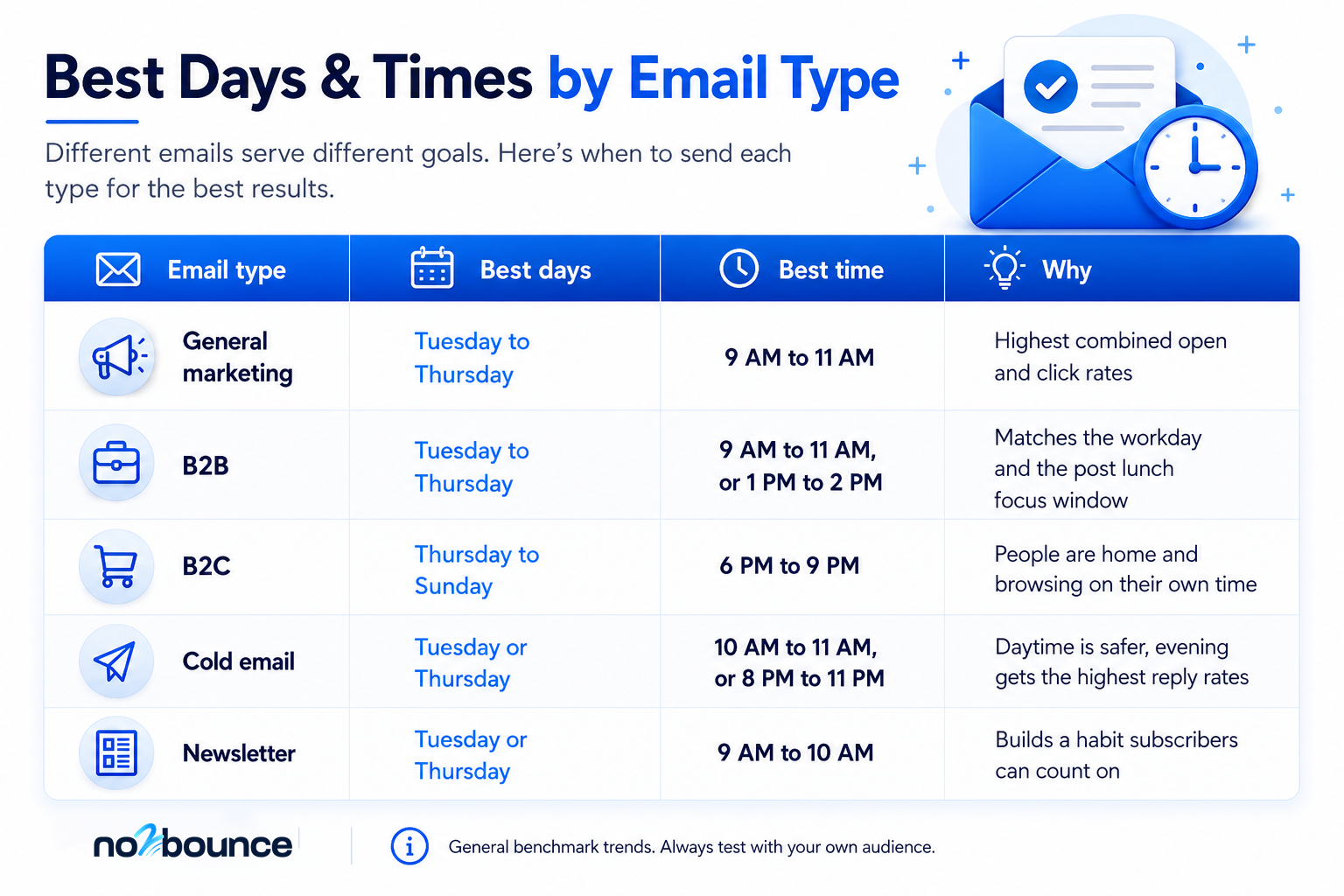
Use this table as your starting point, not your final answer. The sections below explain the reasoning behind each row, and the data that backs it up.
Is There Really a Best Time to Send Emails?
There is a best general window, but there is no single best moment for every business. Every major study lands on the same rough pattern: midweek and mid morning. What changes from study to study is the exact hour, because every dataset blends different industries and audience types together.
Timing matters because attention is not evenly spread across the week. Your subject line might be excellent, but an email that lands at 11 PM on a Friday is competing with the weekend, not your competitors. One large scale study found that almost a quarter of all opens happen within the first hour after delivery. That means a poorly timed send misses its biggest opportunity almost immediately, and no amount of good copy can win back that lost first hour.
Open rate and click through rate also do not peak at the same time. People tend to open emails during quick moments, like first thing in the morning. They tend to click only when they have a free minute to act, which often comes later in the day. So if your main goal is visibility, mornings work best. If your goal is clicks or sales, afternoon and evening sends often perform better. Picking a time means picking which metric you care about most.
This is also why audience behavior matters more than any industry average. A warehouse manager checking email between tasks does not behave like a parent scrolling through a sale email at 8 PM. Benchmarks tell you where to start. Your own list tells you where to land.
Best Days to Send Emails (With Data)
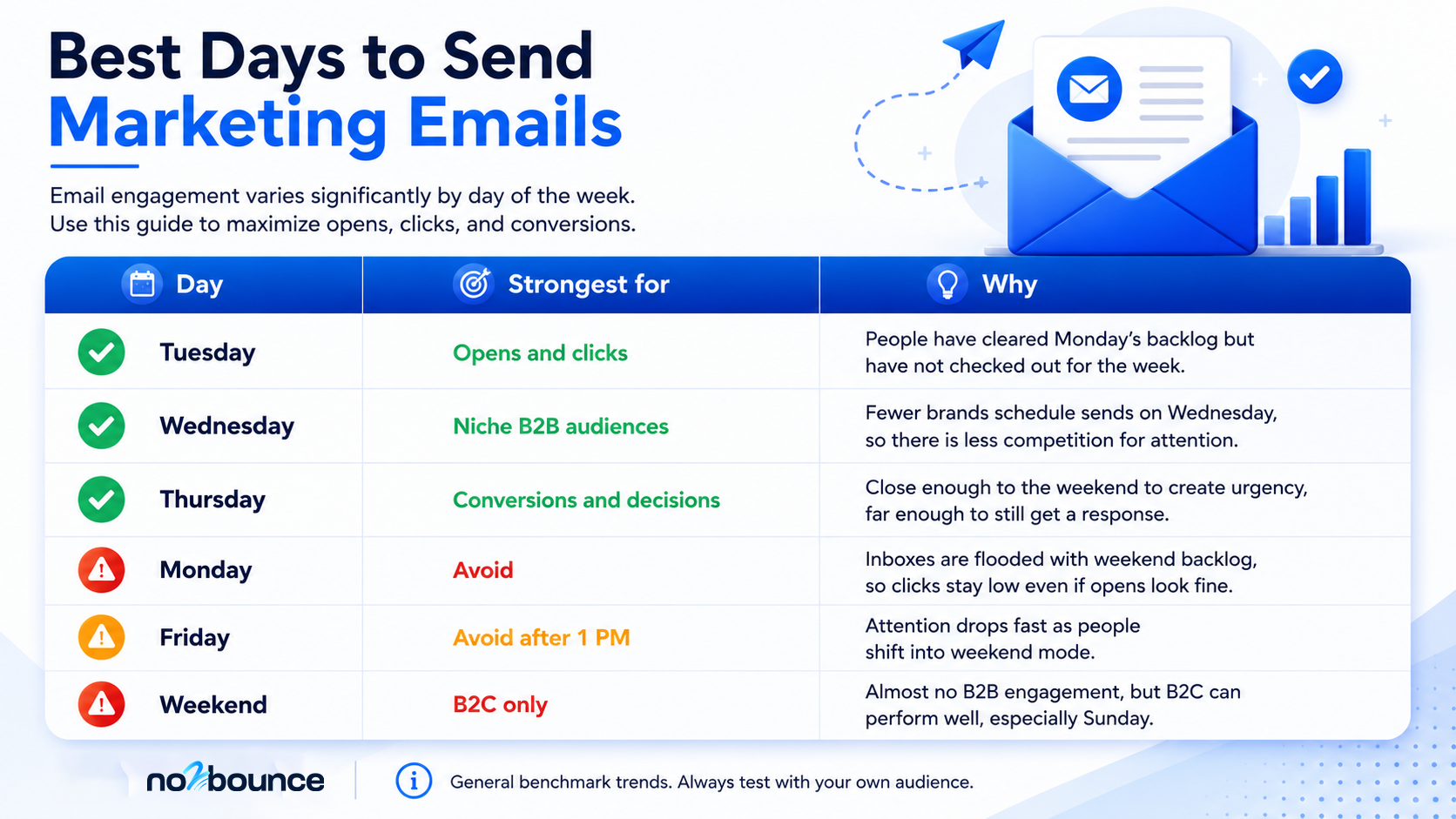
Across large studies, including MailerLite's review of over 2 million campaigns and Omnisend's analysis of close to 26 billion emails, one pattern holds: the middle of the week consistently beats the edges. But Tuesday, Wednesday, and Thursday are not interchangeable. Each one is strong for a different reason.
Tuesday
Tuesday wins more often than any other single day for reach. Omnisend's study found Tuesday had the strongest combination of opens and clicks across the whole week, and several other reports rank it the top day for click through rate on its own. If your main goal is getting in front of as many people as possible, Tuesday is the safest default.
Wednesday
Wednesday rarely wins outright, but it is reliably strong, and that consistency has a hidden benefit. Fewer marketers schedule sends specifically for Wednesday, so inboxes can be slightly less crowded. Several B2B studies list Wednesday as a top day for software companies, agencies, and professional services, where standing out matters more than reaching the widest possible audience.
Thursday
Thursday often wins on the metric that pays the bills: conversions. Campaign Monitor's research found Thursday had the highest open rates of the week, and several ecommerce studies point to Thursday as a strong day for completed orders. The reasoning is simple. Thursday sits close enough to the weekend that people feel some pressure to act, but not so close that they have mentally checked out. Use Thursday for emails that need a decision, like offers, proposals, or anything with a clear call to action.
Which Days to Avoid?
Monday looks fine on open rate, because people are clearing their inbox fast after the weekend. But that speed works against you. People are skimming, not reading, so clicks and real engagement stay low.
Friday holds up reasonably well in the morning, then drops sharply by early afternoon as people shift into weekend mode. Save anything time sensitive for earlier in the week.
Weekends split by audience. Several studies show Saturday as the weakest day overall, since almost no one checks a work inbox. Sunday is the exception worth testing. Some B2C research found a real bump in Sunday evening engagement, as people ease into the week ahead.
Best Time of Day to Send Emails
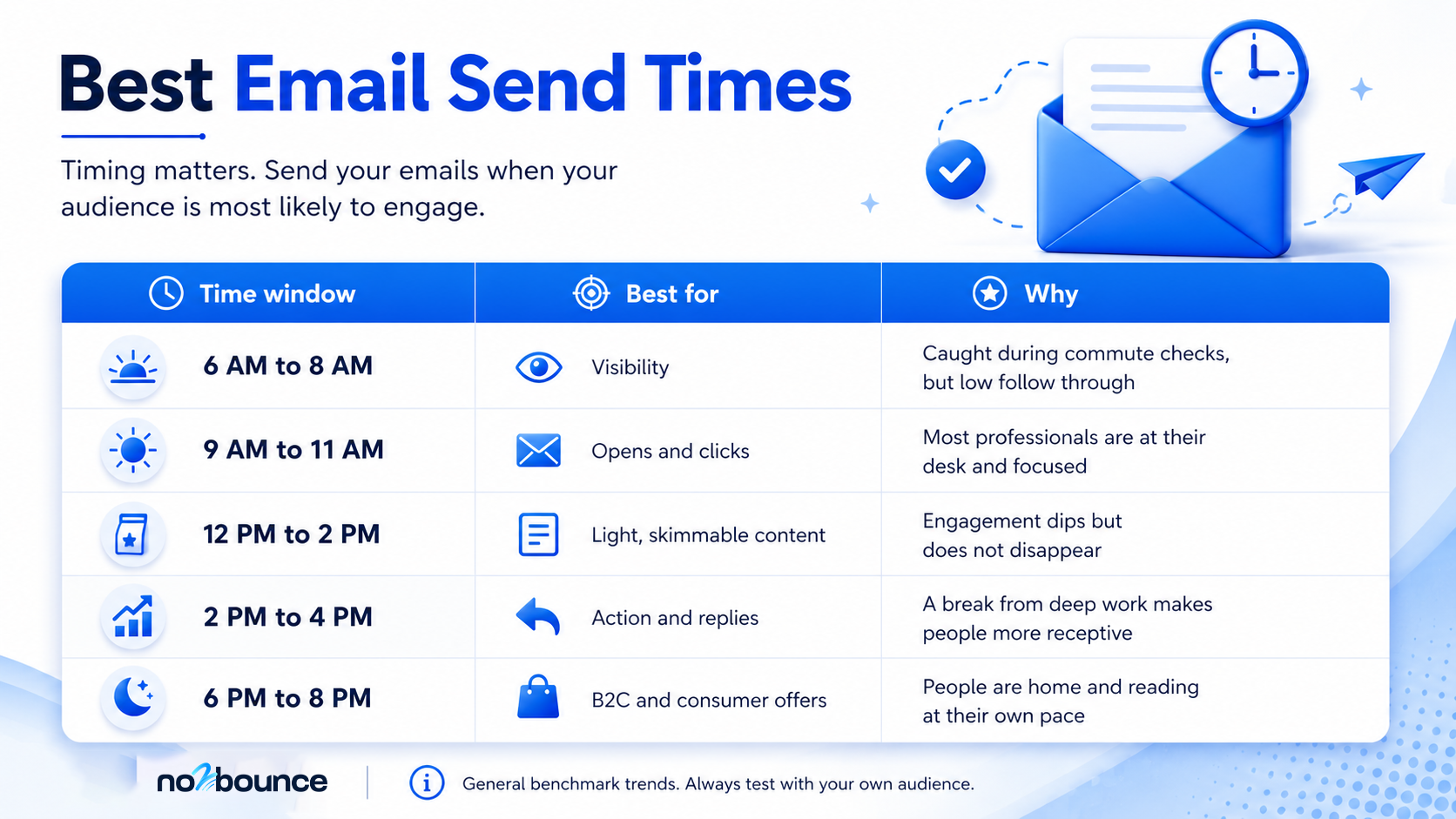
Time of day follows its own rhythm: an early peak, a midday dip, an afternoon recovery, and for consumer audiences, an evening surge.
Early Morning (6 AM–8 AM)
This window catches people in planning mode, scanning subject lines on their commute. Open rates can be surprisingly high here. Some cold email research found that sending between 4 AM and 8 AM landed near the top of a crowded inbox. But clicks and replies stay lower, since people have not settled in to actually act yet. Use this window when visibility matters more than an immediate response.
Morning Work Hours (9 AM–11 AM)
This is the most cited window across nearly every major study, for nearly every audience. By 9 AM, most professionals have cleared overnight notifications and settled into a focused mindset. One survey found that close to half of B2B marketers saw their best engagement in this exact window. If you can only test one send time, start here.
Lunch Break (12 PM–2 PM)
Engagement dips around midday as people step away from their screens, but it does not vanish, it just changes shape. This window favors short, easy to skim content over anything that needs real focus. Some research notes a smaller second peak around 1 PM, when people check email while eating. Treat this as a solid backup slot if your morning window already feels crowded.
Afternoon (2 PM–4 PM)
This is the day's second productivity window, and it shows up repeatedly as a strong slot for clicks and replies. Several B2B cold email studies point to 2 PM to 4 PM as a sweet spot, when people are taking a break from deep work and more open to a relevant message.
Evening Emails (6 PM–8 PM)
This is where B2B and B2C split. For work inboxes, engagement drops sharply after 6 PM. For personal inboxes, this window can beat daytime sends entirely, since people are home, off the clock, and browsing at a relaxed pace. Several ecommerce studies point to early evening as a strong window for sales driven campaigns.
Best Time to Send B2B Emails
The reference table above already gives you the safe default for B2B: Tuesday to Thursday, 9 AM to 11 AM, in the recipient's local time zone. What it does not show is the nuance underneath that number.
Thursday carries extra weight specifically for decisions. Some research found that messages asking for a business decision got noticeably higher response rates when sent on Thursday, likely because there is still time left in the week to act, but enough pressure to not put it off. A second strong window sits around 1 PM to 2 PM, right after the lunch dip, which works well for proposals and follow ups that need a thoughtful response rather than a quick click.
Seniority also changes the math. The more senior the recipient, the tighter their real inbox window tends to be. Some research on executive outreach found that early morning sends, around 6 AM to 9 AM, beat the usual mid morning slot specifically for top level decision makers, since they sort through email before their meetings start. If your list skews toward executives, test an earlier send time before defaulting to 9 AM.
Best Time to Send B2C Emails
Consumer inboxes do not follow a work schedule, and the data reflects that clearly. While B2B activity clusters tightly around office hours, B2C engagement spreads into evenings and weekends, whenever people actually have free time.
Several retail and ecommerce studies point to 6 PM to 9 PM as a strong window, since people are home and browsing on their own time instead of squeezing in a glance between meetings. Friday afternoons and evenings also perform well for B2C, which is the opposite of the B2B pattern, since consumers are shifting into weekend mode and more open to a sale or invitation.
Weekend performance for B2C genuinely holds up, breaking from the usual advice to avoid weekends. Sunday mornings and afternoons show up repeatedly as solid windows for promotions, when people have relaxed, unhurried time to read past the subject line.
One detail matters more for B2C than any send time: most consumer opens happen on mobile, especially outside of work hours. A perfectly timed evening email with a desktop only layout will still lose clicks. Check that your template renders cleanly on a phone screen before you worry about the exact hour.
Best Time to Send Cold Emails
Cold email plays by a different rulebook, because you are earning a reply from a stranger, not an open from someone who already knows you. A study of over 16 million cold B2B emails found the highest reply rates, above 6 percent, came from emails sent between 8 PM and 11 PM, a window that clearly beat normal business hours. The likely reason: by evening, inboxes are quieter, and a well written cold email actually gets read instead of buried under the day's meetings.
Daytime windows still work and remain the safer choice for most senders. 10 AM to 11 AM and 2 PM to 3 PM, on Tuesday or Thursday, show up repeatedly as reliable cold outreach times.
Two details matter more for cold email than for regular marketing email. First, follow up timing has limits. Data from large cold email studies shows reply rates often peak after one or two follow ups, then drop, while unsubscribes and spam complaints climb sharply after a third or fourth message. Stop after two or three. Second, deliverability outweighs timing entirely. No send time trick fixes a damaged sender reputation or a list full of dead addresses. If your domain is not warmed up, you are solving the wrong problem.
Best Time to Send Newsletters
Newsletters work differently than promotional email, because subscribers are opting into a habit, not reacting to a single offer. Consistency matters more here than chasing a perfect hour.
The data still leans toward Tuesday or Thursday, late morning, the same midweek pattern that shows up everywhere else in email marketing. But the bigger lever for newsletters is not the exact hour, it is training subscribers to expect your email at a set time. A newsletter that lands every Tuesday at 9 AM builds a habit. One that arrives at random times never gets the chance to become part of someone's routine. If you have to choose between the theoretically perfect time and a consistent time, pick consistency. It wins for keeping subscribers over the long run.
How Time Zones Affect Email Performance
Every send time number in this guide assumes that 9 AM means the same thing for every reader. For a list that spans more than one region, it does not.
If your list includes people in the US, the UK, and Australia, and you schedule one send for 9 AM Eastern, you hit the East Coast perfectly, catch the West Coast at 6 AM, and land in London well into the afternoon. Only one of those sends is actually well timed.
The fix is time zone aware scheduling: sending each part of your list at the same local hour, not the same server hour. Most email platforms support this through manual list segments by region or automatic send time tools that stagger delivery. For a single country campaign, this matters less. For any list with international subscribers, it is one of the easiest, highest impact fixes available, often improving open rates more than fine tuning the hour within one time zone ever will.
Why Testing Matters More Than Industry Benchmarks
Every number in this guide is an average pulled from millions, sometimes billions, of emails across every industry imaginable. Averages are a useful starting point. They are not your audience.
Your subscribers might be night shift workers, parents who check email after the kids are asleep, or executives who read everything from their phone at 6 AM before anyone else is awake. No industry benchmark accounts for that. Only your own data can.
A simple test settles the question for your list specifically. Split a comparable segment of your audience, send the same email at two different times, and change only one variable, either the day or the hour, so you know what actually caused the difference. Track click through rate and conversion rate alongside open rate, since open rate has gotten noisier as privacy tools like Apple's Mail Privacy Protection generate automated opens that do not reflect real attention. Run the test consistently for a few send cycles before trusting the result, since subscriber habits shift with the seasons and with how often you email them.
Treat the table at the top of this article as your hypothesis. One real test against your own list is worth more than any benchmark in this guide.
Email Timing Won't Help If Your List Contains Invalid Emails
Of the two factors we said move the needle more than timing, matching your audience and keeping your list clean, this second one is entirely within your control today, and it is the one most "best time to send emails" guides skip completely.
If a meaningful share of your contacts are invalid, mistyped, abandoned, or simply fake, it does not matter whether you send at 9 AM on Tuesday or 3 AM on Sunday. Those emails will never get opened, because they will never get delivered. Worse, they actively damage every campaign you send afterward.
Every email sent to an invalid address risks a hard bounce, a permanent rejection that email providers track closely. Too many hard bounces and your sender reputation starts to drop. Once that happens, even your best timed, best written emails start landing in spam folders instead of inboxes, dragging down your open rate and click rate across your entire list, not just the bad addresses. This is exactly why several cold email studies found that deliverability and clean data move the needle more than timing ever does. A perfectly timed email to a dead inbox produces nothing at all.
Email verification and email validation fix this at the source. Checking your list for bad syntax, dead domains, throwaway addresses, and known spam traps before you hit send protects two things at once: your deliverability, and the accuracy of every send time test you run afterward, since a clean list means your results reflect real engagement instead of noise from undeliverable addresses.
Before you spend more time optimizing send times, make sure your list is clean first. Verify your email list with No2Bounce to cut down on hard bounces, protect your sender reputation, and give every campaign a real shot at reaching the inbox, no matter when you choose to send it.
Final Thoughts
There is no single hour that guarantees a winning campaign, but there is a smarter way to approach send time than guessing.
Start with the table at the top of this guide. It is a safe, well supported starting point for most senders. Then confirm it against your own audience, since real subscriber habits will always beat a generic average. Clean your email list before you optimize anything else, since no amount of perfect timing can save a campaign sent to dead or invalid addresses. Keep testing after that, since audience behavior and privacy rules both shift over time, and the best time that works today may not hold next quarter.
Get those four things right, in that order, and email timing stops being a guessing game. It becomes one more lever you control with real data, campaign after campaign.
Frequently Asked Questions
What is the best time to send marketing emails?
Tuesday through Thursday, between 9 AM and 11 AM, performs strongest in most studies for opens and clicks. Treat it as a starting point, then confirm it against your own list, since the audience and industry both shift the exact best hour.
What day gets the highest email open rates?
Tuesday and Thursday are named most often as top performers, with Wednesday close behind. Friday and even Monday can compete on open rate alone, but click through rate and conversions favor the midweek days more consistently.
Is Tuesday better than Thursday?
They win different things. Tuesday tends to lead on reach, meaning opens and clicks. Thursday tends to lead on action, meaning conversions and decisions. Pick Tuesday for visibility and Thursday for anything with a clear call to action.
Should I send emails on weekends?
For B2C, yes, especially Sunday, since people have more relaxed time to engage. For B2B, weekends are usually weak, since almost no one checks a work inbox. Test before ruling weekends out completely, since a small amount of research has found executives catching up during quiet weekend hours.
What is the best time for B2B emails?
Tuesday through Thursday, 9 AM to 11 AM, in the recipient's local time zone, with a second strong window around 1 PM to 2 PM for proposals and follow ups. Send earlier, around 6 AM to 9 AM, if your list skews toward senior executives.
How do I test the best send time?
Split your list into comparable groups, change only one variable at a time, either the day or the hour, and track click through rate and conversion rate alongside open rate. Run the test over several sends before drawing conclusions, since a single campaign can be skewed by the subject line or content, not just the timing.
Start cleaning your list instantly.
No credit card required.