.png)
Email deliverability can make or break your outreach campaigns. While you're crafting perfect subject lines and personalizing your messages, there's a hidden challenge lurking in your contact list: catch-all email addresses.
These addresses represent a significant portion of B2B contacts, often 30-40% of any given list, yet most teams either ignore them completely or send blindly, hoping for the best. Neither approach is ideal.
This comprehensive guide will show you exactly how to handle catch-all emails using no2bounce, turning what most consider a problem into an opportunity for pipeline growth.
Understanding catch-all email
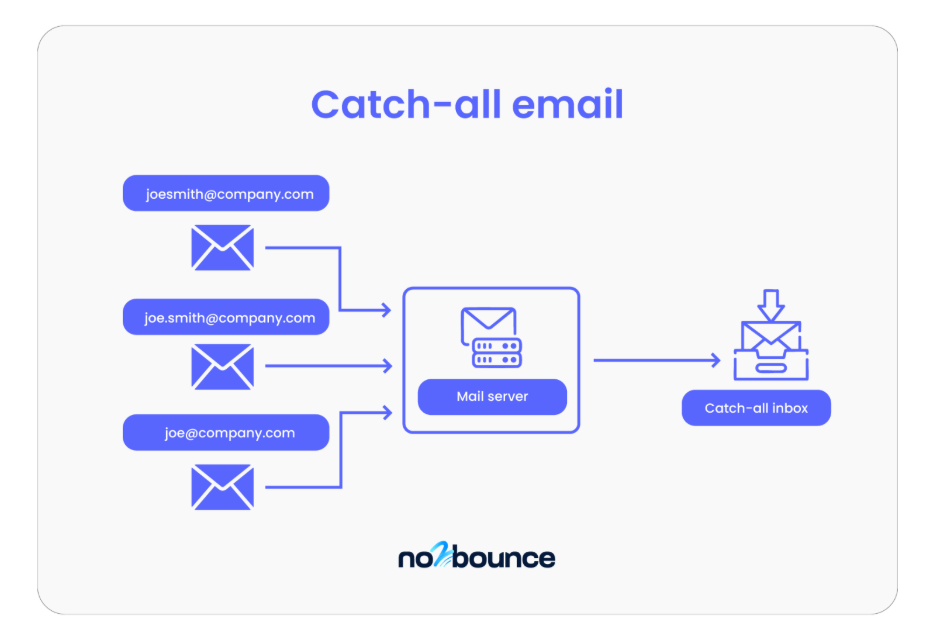
When a company configures its email server with catch-all functionality, the server accepts incoming mail for any address pattern at that domain. There's no immediate rejection for non-existent mailboxes.
Think of it like a business with a general reception area. Whether you ask for "John in Sales" or "Marketing Department" or even make up a name, someone at reception accepts your message. Whether it reaches the right person afterward is another question entirely.
Here's the practical impact: If acme-corp.com runs a catch-all server, these addresses all receive the same response during verification:
Traditional email checkers can't distinguish between real mailboxes and dead ends. This is where advanced verification becomes critical.
The business impact of catch-all addresses
Let's talk numbers. If you're running outbound campaigns and automatically excluding catch-all addresses, you're potentially cutting your reachable audience by a third. That's dozens of qualified prospects removed from every hundred contacts.
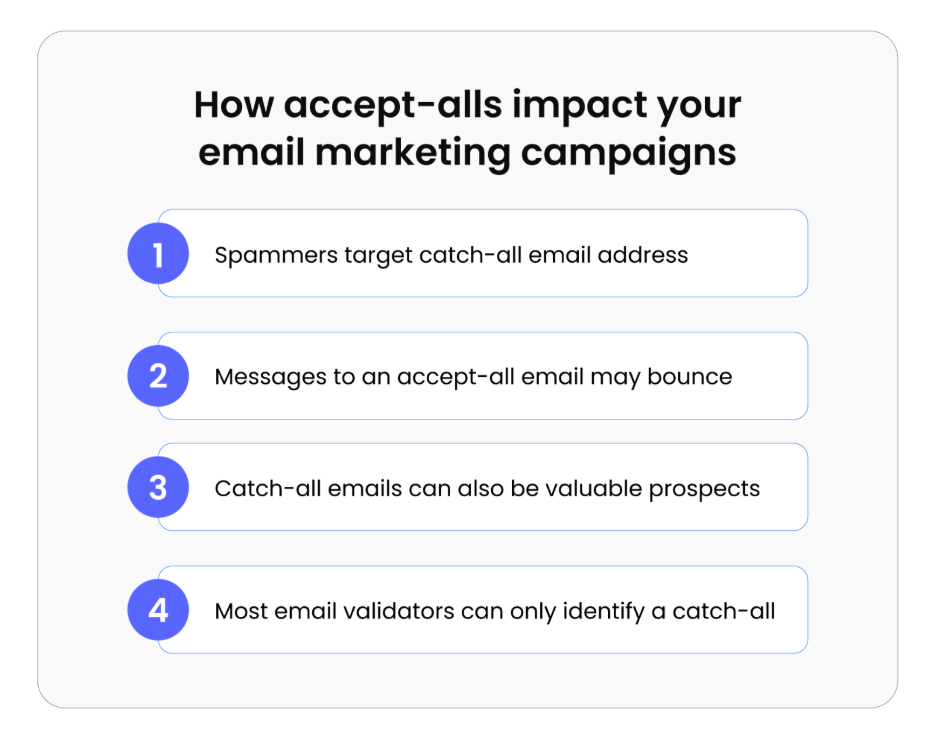
But the opposite approach—sending to every catch-all address—creates different problems:
Your bounce rate climbs as messages hit non-existent mailboxes. Your engagement metrics suffer because many addresses never reach real people. Email service providers notice these patterns and start filtering your messages. Your domain reputation takes a hit, affecting delivery even to verified addresses.
The solution isn't to choose between these extremes. Modern verification tools like no2bounce can evaluate catch-all addresses individually, identifying which ones are worth contacting.
No2bounce's approach to catch-all detection
No2bounce tackles catch-all verification through multiple validation layers working together:
Multi-point SMTP analysis - The system connects to mail servers multiple times with varying parameters, analysing response patterns that indicate actual mailbox existence versus generic catch-all acceptance.
Domain reputation assessment - Not all catch-all domains are equal. No2bounce evaluates domain age, history, and configuration to assess the likelihood of successful delivery.
Pattern recognition technology - The platform has processed millions of catch-all addresses, building intelligence about which patterns correlate with active mailboxes versus abandoned addresses.
Deliverability probability scoring - Rather than a simple pass/fail, you receive a confidence score showing the likelihood your message will reach an actual inbox.
This multi-layered approach means you're not guessing—you're making data-driven decisions about every contact.
We verify catch-all email
Step-by-step verification process
Here's how to implement catch-all email verification effectively with no2bounce:
Phase 1: List preparation
Before uploading anything for verification, clean up obvious problems. Remove duplicate entries, fix common typos in domain names, and eliminate fake addresses. This preprocessing improves accuracy and reduces unnecessary verification costs.
Phase 2: Bulk upload and processing
Upload your complete contact list to no2bounce. The platform automatically separates standard addresses from catch-all configurations, applying appropriate verification methods to each type. Processing happens in real-time for most lists, with results typically available within minutes.
Phase 3: Review detailed results
No2bounce returns granular data for every address:
- Valid: Standard verified addresses ready for immediate outreach
- Invalid: Non-deliverable addresses to remove completely
- Catch-All Valid: Catch-all addresses with high deliverability confidence
- Catch-All Invalid: Catch-all addresses showing signs of inactivity or problems
- Unknown/Risky: Addresses requiring careful handling or exclusion
Phase 4: CRM integration
Export your verified list with status codes intact. Most teams create custom fields in their CRM to store verification status and confidence scores, enabling automated workflow rules.
Phase 5: Campaign segmentation
Build separate sequences for different verification statuses. Your catch-all valid contacts might receive slightly different cadences or have stricter engagement monitoring compared to standard valid addresses.
Related: Step-by-step guide to validate catch-all email addresses.
Handling each verification status
Different verification outcomes require different strategies:
Standard valid addresses
These contacts receive normal treatment. Add them to all campaigns, sequences, and nurture tracks without hesitation. They represent your highest-confidence contacts.
Catch-all valid addresses
Include these in campaigns but implement enhanced monitoring. Track engagement rates separately and remove non-responders more aggressively than your main list. Consider slightly lower sending volumes to this segment initially while you establish engagement patterns.
A practical example: One sales team sends 100 emails daily to standard valid contacts but caps catch-all valid sends at 50 daily, gradually increasing based on positive engagement metrics.
Invalid addresses
Remove immediately and permanently. These contacts will never receive your messages and only harm your sender reputation if you keep trying. Many teams export invalids to a "do not contact" suppression list to prevent reintroduction through future uploads.
Catch-all invalid or risky
Suppress these addresses from active campaigns. Some teams maintain them in a separate "quarantine" segment for potential future re-verification, but they should never enter live sequences without additional validation.
Timing your re-verification cycles
Email infrastructure changes constantly. The catch-all valid address from six months ago might be invalid today. The catch-all invalid address might now be your best prospect's primary inbox.
Establish verification cadences based on your specific situation:
- High-volume senders (1000+ emails daily): Re-verify catch-all segments every 60-90 days. The cost of bad data is too high to wait longer.
- Medium-volume teams (100-1000 emails daily): Quarterly re-verification keeps lists fresh without excessive overhead.
- Low-volume or highly targeted outreach: Re-verify before major campaigns or when reactivating dormant contacts after 6+ months of inactivity.
- Imported or purchased lists: Always verify immediately before any sends. Never trust third-party list quality claims.
Maximising ROI from catch-all verification
The teams seeing the best results from catch-all verification follow these principles:
- Start with high-confidence segments: Begin sending to catch-all valid addresses with the highest deliverability scores. Prove the value before expanding to lower-confidence contacts.
- Monitor engagement obsessively: Set up dashboard tracking specifically for catch-all segments. You should know within the first week whether your approach is working.
- Adjust quickly based on data: If bounce rates exceed 5% or engagement is significantly below your standard list performance, pause and reassess. Don't keep sending to segments that aren't performing.
- A/B test your approach: Try different sending volumes, cadences, and content variations with catch-all segments to find what works best for your audience.
- Document your learnings: Build institutional knowledge about which catch-all domain types perform well for your specific industry and offer.
No2bounce Feature Highlights
Verify and protect your email data at every stage. We combines real-time validation, scalable bulk processing, domain-level intelligence, and clear reporting to help you maintain clean lists and strong deliverability.
Instant API verification
Verify email addresses the moment they enter your system through form submissions, imports, or manual additions. No2bounce's API responds in milliseconds, enabling real-time validation without workflow delays.
Bulk processing power
Upload lists of any size—from hundreds to millions of contacts—with automated processing and downloadable results files mapped to your original data structure.
Domain-level intelligence
Beyond individual addresses, no2bounce evaluates entire domains for catch-all configuration, spam trap presence, and historical deliverability data.
Detailed reporting dashboard
Access comprehensive analytics showing verification results over time, helping you identify trends and optimise list quality.
Common questions about catch-all verification
What exactly happens during catch-all verification?
No2bounce performs advanced SMTP handshakes with the target mail server, tests multiple addresses at the domain, analyses response patterns, checks domain configuration and reputation, then applies proprietary algorithms to assess deliverability probability. All of this happens without sending messages to the addresses.
How should I verify large contact databases?
For databases with thousands of contacts, use no2bounce's bulk upload feature. Prepare your file in CSV format, upload it through the dashboard, and the system processes all addresses simultaneously. You'll receive a downloadable results file with verification status for every contact, typically within minutes for most list sizes.
What do the different verification statuses mean?
No2bounce returns precise status codes: Valid means the address exists and accepts mail; Invalid means it's non-deliverable; Catch-All Valid indicates a catch-all domain with high delivery probability; Catch-All Invalid shows a catch-all domain with delivery concerns; Risky/Unknown suggests uncertainty requiring careful handling or exclusion from critical campaigns.
Can I test no2bounce before committing?
Absolutely. No2bounce offers 100 free credits allowing you to verify a batch of addresses, review the result format, and confirm the system meets your needs before any financial commitment.
How accurate is the catch-all assessment?
While no verification system can guarantee 100% accuracy for catch-all addresses (since they technically accept all mail), no2bounce's multi-factor analysis provides reliable deliverability prediction. Most users report catch-all valid addresses performing 10-15% of standard valid addresses for delivery and engagement.
Should every catch-all address be excluded from campaigns?
Not at all. Catch-all addresses marked as "catch-all valid" by no2bounce have been assessed as having high deliverability probability. Many of your best prospects may have catch-all addresses. The key is using verification to separate the likely-deliverable addresses from the probable dead ends.
How often should I re-verify contacts?
This depends on your sending volume and list age. Generally, re-verify any contacts older than 6 months before major campaigns, re-verify imported or purchased lists immediately, and establish a quarterly verification cycle for your active database to maintain optimal quality.
Get Started with no2bounce
Improving your catch-all verification process starts with a simple step: testing the platform using your real data. Upload a segment of your contact list, review the detailed validation results, and objectively compare catch-all “valid” addresses against your current approach.
Most teams quickly uncover missed opportunities and hidden risks they were previously unaware of. Your next high-performing campaign may already exist within the catch-all addresses you’ve been excluding. No2bounce helps you identify which ones are genuinely worth engaging.
Ready to recover leads hiding in your catch-all addresses? Start verifying with no2bounce today.
Start cleaning your list instantly.
No credit card required.