.png)
If you are running email marketing today, you are operating in a privacy-first and performance-driven environment. Inbox providers are stricter than ever, data privacy regulations are expanding globally, and subscribers expect transparency in how their personal data is handled. In this landscape, email validation, email verification, and data privacy compliance are no longer optional, they are essential.
This is where a platform like no2bounce becomes critical. By helping you validate email addresses at the point of entry, verify deliverability and risk, and maintain clean data continuously, no2bounce enables you to protect inbox placement while supporting compliance with global privacy standards.
When your email data is inaccurate or outdated, the impact goes far beyond poor campaign performance. You increase bounce rates, trigger spam filters, retain unnecessary personal data, and expose your organisation to regulatory and reputational risk. This blog explains how validation, verification, and compliance work together—and how you can implement them as part of a sustainable, global email marketing strategy.
Quick summary: Email validation, verification, and compliance
- Email validation checks whether an email address is correctly formatted and linked to a valid domain.
- Email verification determines whether the address can safely receive emails and whether it poses deliverability or compliance risk.
- Data privacy compliance requires you to keep email data accurate, relevant, and permission-based.
Using an email verification platform like no2bounce helps you reduce risk, improve deliverability, and meet modern privacy expectations across regions.
Email Validation vs Email Verification: Understanding the difference
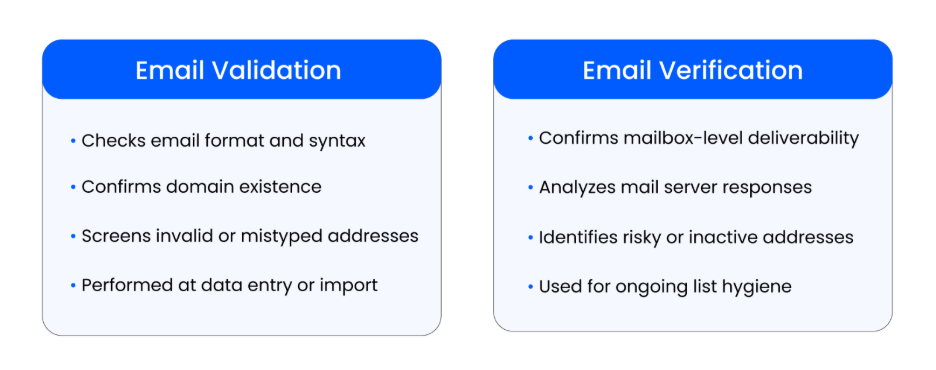
To maintain compliant and high-performing email lists, you must clearly understand the difference between validation and verification.
Email validation confirms that an email address follows proper syntax rules and that the domain exists. It answers the question: Does this email address look technically correct?
Email verification goes further by assessing whether the mailbox can actually receive messages and whether the address presents risk, such as being inactive, disposable, or associated with abuse patterns.
Why do you need both?
- Validation prevents obvious errors at the point of data capture
- Verification reduces bounces, complaints, and risky sends
- Together, they support data accuracy, a core privacy requirement
Using one without the other leaves gaps that affect both compliance and deliverability.
The role of data privacy compliance in email marketing
Data privacy regulations govern how you collect, store, and use email addresses. While laws differ by region, most are built on shared principles:
- Lawful and transparent data collection
- Purpose limitation and relevance
- Data minimization
- Accuracy and regular updates
- Respect for user rights and preferences
For you as a marketer, this means email data must be treated as living personal data, not a static asset. Email lists require continuous maintenance to remain compliant and effective.
How clean email data supports privacy-first marketing
Clean email data directly supports privacy compliance while improving campaign results.
When you maintain verified and up-to-date email lists, you:
- Reduce unnecessary storage of personal data
- Minimise spam complaints and unsubscribe friction
- Improve engagement and sender reputation
- Demonstrate responsible data handling practices
Regular verification shows that you value accuracy and relevance—two principles enforced by both regulators and inbox providers.
Understanding catch-all and accept-all email addresses
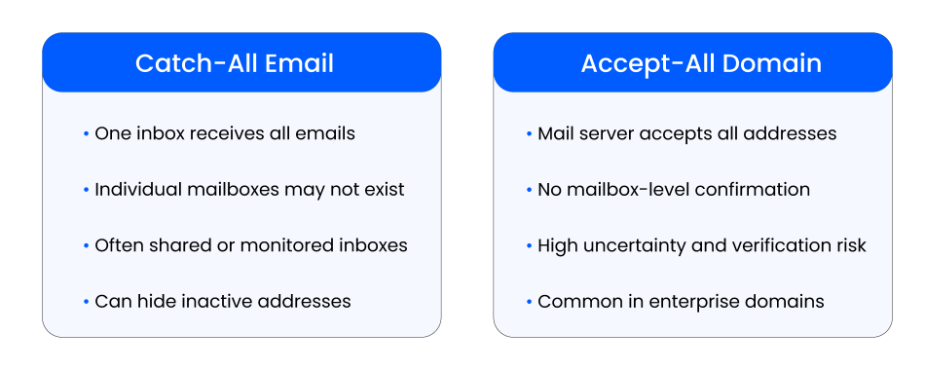
Catch-all and accept-all email addresses are often grouped together, but they behave differently and create distinct risks for deliverability and compliance.
What is a catch-all email address?
A catch-all email address exists when a domain is configured to receive emails sent to any address that does not have a specific mailbox.
For example, emails sent to sales@company.com, info@company.com, or even random@company.com may all be delivered to a single inbox if a catch-all rule is enabled.
Why catch-all email addresses create risk
- You cannot confirm whether the intended recipient exists
- Messages often route to shared or monitored inboxes
- Engagement signals are inconsistent or unclear
- Inactive addresses can remain hidden for long periods
From a compliance perspective, continuing to email unresponsive catch-all addresses may conflict with expectations around data accuracy and relevance.
What is an accept-all email domain?
An accept-all email domain is a domain-level configuration where the mail server signals that it will accept all incoming emails during verification checks, regardless of whether the mailbox exists.
Unlike catch-all inboxes, accept-all behavior occurs at the server's response level, making it difficult to confirm real deliverability.
Why accept-all domains increase risk
- Mail servers do not confirm mailbox existence
- Verification results remain inconclusive
- Invalid or abandoned addresses go undetected
- Long-term sending may lead to bounces or complaints
Because accept-all domains prevent precise verification, ongoing engagement monitoring is essential to avoid compliance and reputation issues.
Identifying and managing risky email addresses
Risky email addresses are not always invalid, but they increase both deliverability and compliance risk. Common examples include:
- Disposable or temporary email addresses
- Role-based addresses such as info@ or admin@
- Long inactive or unengaged recipients
- Addresses associated with suspicious sending behavior
You should identify these addresses during verification and manage them through segmentation, suppression, or stricter engagement thresholds.
How email verification helps reduce compliance risk
Email verification supports compliance by helping you meet data accuracy and minimization principles.
When you verify your email lists consistently, you:
- Remove invalid and non-responsive addresses
- Avoid retaining unnecessary personal data
- Reduce complaints and unsubscribe rates
- Support internal compliance reviews and audits
Verification should be treated as an ongoing operational discipline, not a one-time cleanup.
Using an email checker for continuous validation and compliance
An email checker allows you to control data quality throughout the customer lifecycle.
You can use it to:
- Validate emails in real time at signup
- Verify bulk lists before campaigns
- Monitor existing databases for natural decay
By preventing bad data from entering your systems, you reduce downstream issues across CRMs, automation tools, and analytics platforms while strengthening compliance.
Common email compliance mistakes you should avoid
Many compliance and deliverability issues stem from avoidable practices, including:
- Using outdated or purchased email lists
- Assuming opt-out equals permission to continue sending
- Failing to re-verify dormant segments
- Treating compliance as a one-time legal exercise
Avoiding these mistakes protects both your campaigns and your brand reputation.
Email compliance checklist for marketers
Use this checklist to align your email marketing with best practices:
- Collect clear and documented consent
- Display transparent privacy notices
- Validate emails at data entry
- Verify lists regularly
- Flag catch-all and accept-all domains
- Suppress risky or inactive addresses
- Provide clear unsubscribe options
- Monitor engagement and complaint metrics
Email compliance requirements by region
Email compliance for EU and UK marketers
If you target users in the EU or UK, you must prioritize:
- Consent or lawful processing
- Accurate and up-to-date email data
- Purpose limitation and relevance
- Ongoing list verification
Email verification supports GDPR and PECR principles by reducing unnecessary data retention.
Email privacy rules for US businesses
In the United States, compliance focuses on:
- Clear sender identification
- Honest subject lines
- Easy and immediate opt-out mechanisms
- Prompt handling of unsubscribe requests
While opt-in rules are less strict, clean email data reduces complaints and improves inbox placement.
Global email sending best practices
If you send emails globally, the safest approach is to:
- Apply the strictest regional standard universally
- Maintain consistent validation and verification workflows
- Monitor engagement by region
FAQ Section
- What is the difference between email validation and email verification?
Email validation checks formatting and domain existence, while email verification confirms whether an address can safely receive emails.
- Is email verification required for GDPR compliance?
It is not explicitly required, but it strongly supports GDPR principles of data accuracy and minimisation.
- Are catch-all email addresses compliant to email?
They are not prohibited, but repeatedly emailing unresponsive catch-all addresses may conflict with data relevance expectations.
- What is an accept-all email domain?
An accept-all domain accepts all emails at the server level, making it difficult to confirm true deliverability.
- How often should you verify your email list?
You should verify at acquisition and re-verify regularly, especially before major campaigns.
- Is email verification useful for global campaigns?
Yes. It helps maintain consistent data quality, deliverability, and compliance across regions.
Building a sustainable, privacy-first email marketing strategy
To succeed in the long term, you must treat email validation, verification, and privacy compliance as ongoing practices, not one-time tasks.
By using no2bounce, you give yourself the tools to:
- Maintain accurate, compliant email data globally
- Reduce deliverability and regulatory risk
- Build trust with inbox providers and subscribers
- Scale email marketing responsibly
In a privacy-first world, clean email data is not just operational hygiene, it is your credibility as a marketer.
Start cleaning your list instantly.
No credit card required.