.jpg)
Sending an email to an invalid address feels like nothing at first. No error pops up on your screen, no alarm goes off. The message just quietly fails somewhere between your server and a mailbox that doesn't exist. But that quiet failure isn't harmless. It's the single most common way otherwise well-run email programs end up in the spam folder, throttled, or locked out of their own ESP account.
Here's exactly what happens when you send to an invalid address, why it does more damage than people expect, and what actually fixes it.
What "Invalid" Actually Covers
"Invalid" isn't one thing. It's a spectrum from an obvious typo to a mailbox that was perfectly fine last year and is dead now, and each type carries a different level of risk to your sender reputation.
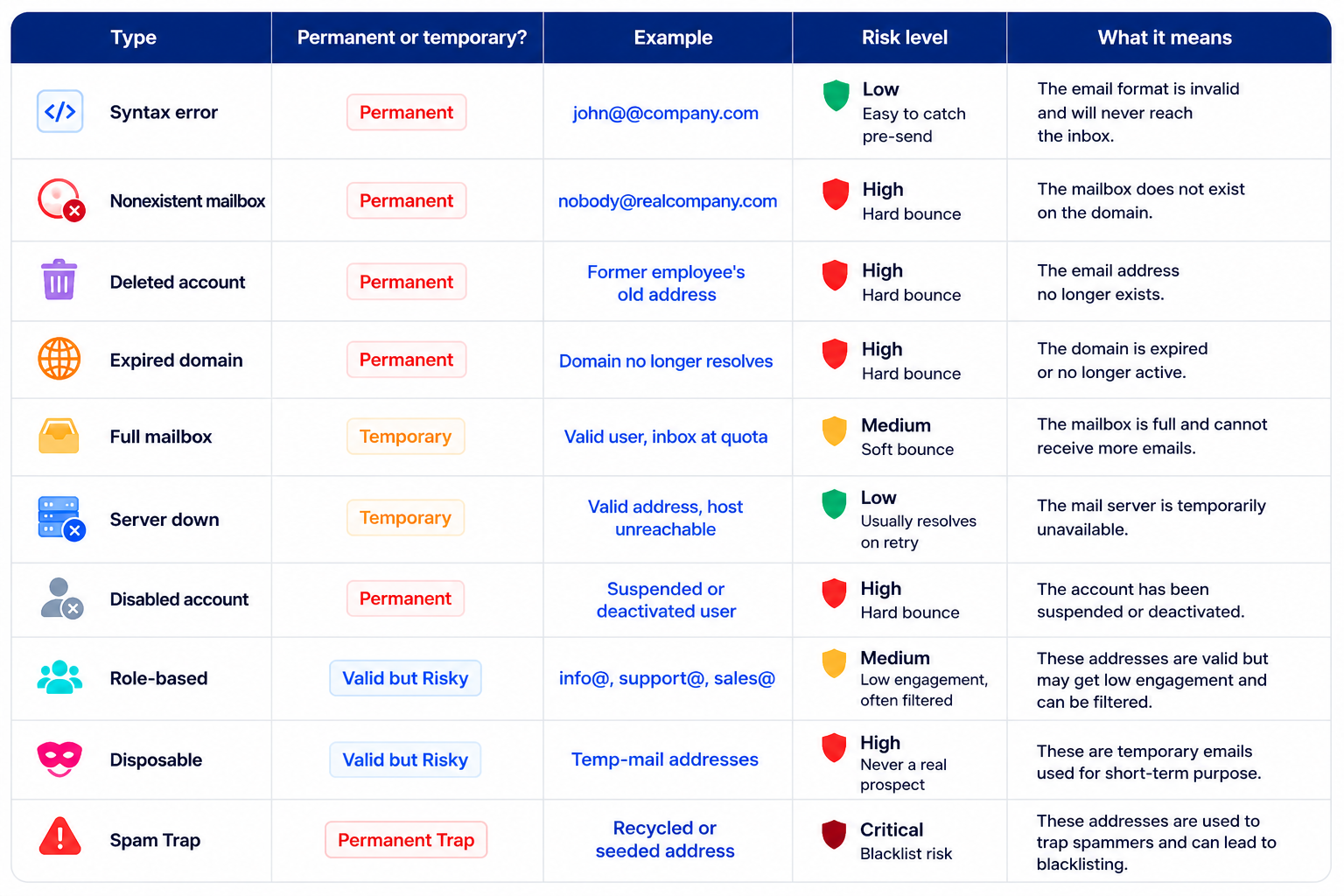
The permanent categories all produce what's called a hard bounce. The temporary ones produce a soft bounce. That distinction matters because the fix is completely different: soft bounces are worth retrying, while hard-bounced addresses need to be removed from your list immediately and never sent to again.
Technically, you can tell the two apart by the SMTP response code the receiving server sends back. Codes starting with 5 (most commonly 550 5.1.1, "user unknown") mean permanent failure. Codes starting with 4 (like 421 or 452) mean temporary failure, worth a retry. Not every server follows this convention perfectly, but it's the standard your ESP is working from behind the scenes.
Why One Bounce Turns Into a Bigger Problem
A single invalid address bouncing is not, on its own, a crisis. The real damage comes from what happens when it's not an isolated incident, and from how fast lists actually decay.
Independent list-decay tracking has put annual invalid/risky rates in the 22-28% range over the past several years, meaning roughly one in four addresses in a database that was clean a year ago is now bad. That's not a worst-case scenario, it's the baseline. If you're not re-verifying on a regular cadence, you're sending into a list that's degrading faster than it looks from the outside, since bad addresses accumulate silently until a bounce spike makes the damage visible all at once.
Every mailbox provider (Gmail, Outlook, Yahoo) and every ESP (Mailchimp, SendGrid, HubSpot, Klaviyo, Amazon SES) tracks your bounce rate as a core sender reputation signal. The benchmarks are consistent across the industry:
- Under 2% total bounce rate is considered healthy
- 2-5% signals a list quality problem that needs attention
- Above 5% is treated as an emergency by most ESPs, and commonly triggers automatic throttling, account review, or suspension
- Most deliverability practitioners treat hard bounces specifically as needing to stay under 1%, since they're the most damaging bounce type
This isn't just an industry rule of thumb anymore, it's tied to actual policy. Since February 2024, Gmail and Yahoo have required bulk senders (5,000+ emails per day) to authenticate with SPF, DKIM, and DMARC, provide one-click unsubscribe, and keep spam complaint rates under 0.3%. A list full of invalid addresses makes every one of those requirements harder to hit, because hard bounces and complaint-triggering both erode the same reputation signals these providers are now formally enforcing.
And it compounds. Once your bounce rate pushes your sender reputation down, mailbox providers don't just penalize the bounced sends, they start routing your legitimate mail, to real, engaged subscribers, into spam folders too. You end up paying a reputation tax on every future email, not just the ones that bounced. A bounce rate that creeps from under 1% to 3-4% over a few months of an uncleaned list is one of the most common ways businesses find themselves suddenly unable to send at all.
How Invalid Addresses End Up on Your List
A few sources account for almost all of it:
- Purchased or scraped lists, which mix real addresses with fabricated ones and outdated data
- Simple typos at signup, especially on mobile keyboards ("gmial.com" instead of "gmail.com")
- Natural decay, as people change jobs, switch providers, or abandon old inboxes over time
- No signup validation, letting bots or careless entries through unchecked
- Catch-all domains, which accept mail for any address at that domain regardless of whether the specific mailbox exists, masking invalid entries as if they were valid
No signup validation is worth flagging specifically because it's the easiest to fix and the most commonly ignored. If your signup form accepts anything shaped like an email address without checking whether it's real, you're guaranteed to accumulate invalid entries over time, even with an entirely organic, opt-in audience.
What to Actually Do With Flagged Addresses
Once you've run a verification pass, you'll end up with addresses sorted into a few buckets, and each one needs different handling.
Hard bounces / confirmed invalid: suppress immediately and permanently. There's no retry that fixes a nonexistent mailbox, and every additional send to it is pure reputation damage with no upside.
Soft bounces: give them a small number of retries (three consecutive attempts is a common operational rule) before treating them as dead. Most ESPs handle the retry logic automatically, but if the same address soft-bounces across multiple separate campaigns, it should move into the suppress bucket.
Catch-all and unknown results: this is the genuine gray zone. The verification pass couldn't confirm or deny the mailbox exists. These need periodic re-checking rather than a one-time decision, since catch-all configurations change over time, a domain that accepted everything last month might start rejecting nonexistent mailboxes today.
Suppress or delete? This is a workflow decision more than a data quality one. Suppressing keeps the contact record intact (useful in a CRM where the person has value beyond the email address) while blocking future sends. Deleting removes the record entirely, which is usually the right call for a pure marketing list where the email address is the only data point you hold on that contact.
Where No2Bounce Fits Into This
This is the exact gap no2bounce's email verification tool is built to close. It runs each address through syntax, domain, MX, and SMTP-level checks before you ever hit send, flags catch-all domains separately rather than lumping them in as invalid, and scores overall deliverability risk through email scoring so you can see which parts of a list are safe to mail and which need attention first. For bulk lists, that means catching invalid entries before a campaign goes out rather than finding out from a spike in bounce reports afterward.
Where No2Bounce differs from list-cleaning tools that only run once a quarter: credits never expire, which matters specifically because list decay is ongoing rather than a one-time problem. A list verified in January is not the list you're sending to in June, so a tool built around occasional bulk cleanups will always be catching up to reality rather than staying ahead of it.
None of this makes a list bulletproof forever, since new addresses go stale the moment people change jobs or close old inboxes. What it does is keep the invalid-address problem where it belongs: caught before you send, rather than discovered through a damaged sender reputation after the fact.
FAQ
What's the difference between an invalid email and an inactive one?
An invalid address can't receive mail at all, it bounces immediately. An inactive address is technically valid and can receive mail, but the person hasn't opened or clicked anything in a long time. They need different treatment: invalid addresses should be removed, while inactive ones are better handled through a re-engagement campaign or list segmentation.
How high can my bounce rate go before it's a real problem?
Industry consensus puts 2% total bounce rate as the line where a healthy list becomes a list quality problem, with hard bounces specifically needing to stay under 1%. Above 5% total, most major ESPs will actively throttle sending or flag the account for review, and some enforce suspension at that threshold or lower.
Does one bounce actually hurt my sender reputation?
Not meaningfully on its own. The damage comes from a pattern of bounces over time, which mailbox providers and ESPs both track and weigh heavily when deciding whether your future mail reaches the inbox or the spam folder.
Start cleaning your list instantly.
No credit card required.