
Most articles on this topic say "machine learning detects patterns" four or five different ways and leave you knowing nothing.
So here is the specific version. Email verification has a hard boundary: a set of checks that return facts, and beyond that, a set of questions no protocol can answer. Machine learning is only useful on one side of that boundary. Understanding which side is the difference between buying a verifier that works and buying a blocklist with an AI badge on it.
What deterministic verification already answers
Four layers of email verification need no machine learning at all, and any vendor selling you AI for these is selling you nothing.
Syntax validation. Does the address conform to RFC 5322? This is a parsing problem with a defined specification. It is solved.
Domain and DNS checks. Does the domain resolve? Does it publish MX records, and do those records point somewhere that accepts mail? These are DNS lookups. The answer is a fact.
Role-based detection. Is this info@, support@, billing@, noreply@? Pattern matching against a known list of role prefixes handles the vast majority of cases.
Known disposable domains. If mailinator.com is on your blocklist, matching against the blocklist is a lookup, not a prediction.
SMTP mailbox verification. This is the important one. A verifier opens a conversation with the recipient's mail server and issues a RCPT TO command, effectively asking "does this mailbox exist?" without sending a message. When the server answers honestly, that answer is authoritative. No model improves on it.
That last sentence carries the whole article, because increasingly, servers do not answer honestly.
Where the deterministic approach runs out
Six situations break SMTP verification. These are the gaps, and they are where machine learning either earns its place or doesn't.
1. Catch-all domains
A catch-all domain is configured to accept mail addressed to anything at that domain. jane.doe@acme.com and qz47xk@acme.com both get a 250 OK. The server is not lying, since it genuinely will accept both, but it has told you nothing about whether a mailbox exists behind either one.
This is the single largest ambiguity in email verification, and it is heavily concentrated in exactly the segment that matters most for B2B: company-owned domains, often on Google Workspace or Microsoft 365, configured catch-all so nothing addressed to the company gets lost.
Deterministic verification cannot resolve a catch-all. It has two options. It can report "unknown," which pushes the decision back onto you with no information, or it can predict. Prediction is a machine learning problem, and it is the reason catch-all verification exists as a separate capability rather than a line item in a standard check.
2. Mailboxes that exist but are abandoned
An employee left three years ago. IT never deleted the account. SMTP confirms the mailbox exists, and it does. It accepts mail into a void nobody opens.
This address is technically valid and practically worthless. Worse, abandoned mailboxes at consumer providers are the raw material for recycled spam traps: providers eventually repurpose long-dormant addresses specifically to catch senders mailing stale lists. SMTP cannot see dormancy. There is no protocol-level question that returns "last opened in 2023."
3. Disposable domains that don't exist yet
Throwaway domains spin up continuously, and a blocklist is by definition a record of what was already discovered. The window between a disposable service launching a new domain and that domain appearing on commercial blocklists is where the leakage happens.
Catching these before they're listed means recognising the shape of a disposable service (registration recency, MX configuration, hosting patterns, domain naming conventions) rather than matching a name.
4. Servers that deliberately obstruct verification
Large providers do not want to be a mailbox-existence oracle for anyone with a list. So they greylist, rate-limit, tarpit, and return deliberately ambiguous temporary-failure codes to traffic that looks like verification rather than delivery.
A deterministic system receives "try again later" and has no answer. It can retry, hit the same wall, and eventually time out. Getting a usable signal out of these servers depends as much on the infrastructure the probes originate from as on the logic interpreting the responses.
5. Accept-then-bounce configurations
Some servers accept at SMTP and then bounce the message asynchronously after examining it. The handshake said yes. The delivery attempt failed hours later. Any verifier relying purely on the handshake will have reported that address valid.
6. Pristine spam traps
A pristine trap is an address that has never belonged to a human and has never opted in to anything. It exists solely to be scraped, so that anyone who mails it demonstrably built their list without consent. It accepts mail. It looks entirely valid at every deterministic layer.
The only available signal is circumstantial: how the address is structured, where addresses like it tend to come from, whether it resembles other addresses later confirmed as traps.
What a model actually trains on
Here is the part usually skipped. An ML verification model is a tabular classifier. It takes a set of measured features about an address and its domain and outputs a probability. The features are concrete and mostly unglamorous.
Domain-level features
- Domain age from registration records. A domain created eleven days ago behaves very differently from one created in 2009.
- Which mail provider the MX records point to, and whether that provider validates per-mailbox or accepts blanket.
- Whether the domain publishes SPF, DKIM, and DMARC, and how completely. Real operating companies configure authentication; throwaway domains usually don't.
- Whether a live website exists at the domain.
- TLD-level historical outcomes.
- Whether the domain is configured catch-all.
Address-level features
- Structure of the local part. Does j.smith fit a firstname.lastname convention, or is xk92jq high-entropy in a way real humans and real IT naming policies rarely produce?
- Length and character distribution of the local part.
- Presence of role or automation keywords.
- Convention fit within the same domain. This is the most underrated signal in catch-all resolution. If you have previously confirmed forty addresses at acme.com and every one follows first.last@, then sarah.chen@acme.com fits the observed convention and sc4471@acme.com does not. You are inferring the organisation's naming policy from confirmed examples and scoring new addresses against it.
Outcome history
- Prior bounce results for the same domain.
- Prior bounce results for addresses structurally similar to this one.
- How long ago the address first appeared in circulation.
- Engagement and sender-side quality signals where available.
SMTP behavioural features
- Response timing and error-code patterns.
- Whether the server's behaviour across many probes suggests genuine per-mailbox lookup or blanket acceptance.
The labels are the whole game
A supervised model needs ground truth, and in email verification ground truth has exactly one source: what actually happened when mail was sent. Did it hard bounce? Soft bounce? Deliver? Get engaged with?
This is the point that separates real ML verification from marketing. The model's quality is a direct function of the volume, recency, and breadth of real send outcomes it learns from. That is the asset, not the algorithm. The algorithms are commodity, and for tabular data with engineered features like this, gradient-boosted decision trees do most of the work, with anomaly detection layered in for novel-pattern addresses. You can read how they work in an afternoon.
What you cannot commodity-source is a continuously refreshed record of which predictions turned out to be right. That record only accumulates at volume, which is why the practical quality gap between verifiers tends to show up on large list runs rather than on single lookups.
The feedback loop, or it isn't machine learning
Predictions go out. Mail gets sent. Bounces come back. Bounce outcomes become labels. The model retrains. Predictions improve.
Break that loop and you have heuristics with extra steps. Worse is the failure mode where a vendor trains on its own previous predictions rather than on real send outcomes. The model then learns to agree with itself, confidence climbs, and accuracy quietly detaches from reality. It is worth asking vendors about directly.
Calibration matters more than accuracy
A model that outputs 0.85 should be right about 85% of the time on addresses it scores 0.85. That property is called calibration, and it is what makes a confidence score usable.
An uncalibrated score is actively harmful, because you will act on it. If "90% confident" actually means 60% in practice, you'll mail a segment you believed was safe, and you'll find out from your bounce rate. For catch-all addresses in particular, where a probability is genuinely the best answer available, calibration is the thing that determines whether that probability is useful or decorative.
Where ML helps, and where it doesn't
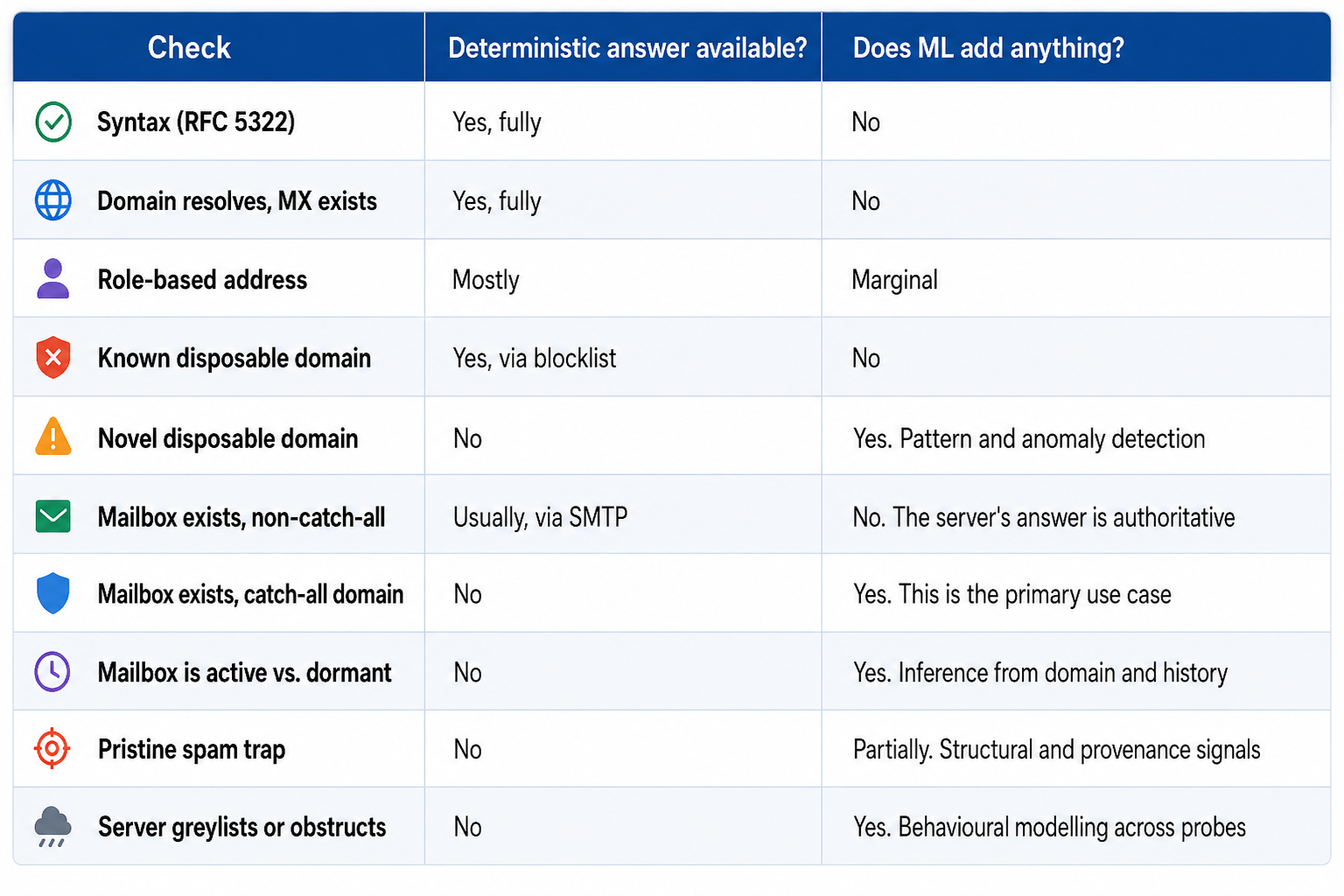
Read that table as a filter. If a vendor's ML story is concentrated in the top rows, the ML is decorative.
What machine learning cannot do
Being straight about the limits is more useful than another paragraph about the power of AI.
It cannot override a definitive answer. When a mail server hard-rejects an address, that address is invalid. No model improves on a fact.
It cannot see inside a mailbox. No verifier knows whether a human reads that inbox. Dormancy prediction is inference from correlates, and it will sometimes be wrong.
It cannot turn a probability into a certainty. Catch-all resolution produces probabilities because the underlying question is unanswerable at the protocol level. A vendor claiming near-certainty on catch-all addresses is claiming to have solved something unsolvable, and you should ask how.
It cannot fix consent, and this is the big one. A perfectly deliverable address you have no permission to email will still generate spam complaints. Verification addresses validity. It does not address whether anyone wanted to hear from you, and under current enforcement, wanted-ness is what actually determines your fate.
And it isn't NLP. You'll see claims that natural language processing powers email verification. There is no natural language in an email address to process. Recognising that qz47xk is structurally unlike sarah.chen is pattern recognition over character distributions. Calling it NLP is dressing up something ordinary.
Why the margin for error narrowed
The reason list hygiene stopped being housekeeping and became infrastructure is that the major providers changed how they enforce.
Since February 2024, Gmail and Yahoo classify anyone sending 5,000 or more messages a day to their users as a bulk sender, triggering mandatory SPF and DKIM authentication, a published DMARC record, one-click unsubscribe, and a spam-complaint rate held under 0.3%. Google's guidance is to stay below 0.1%; the 0.3% figure is where enforcement starts, not a target to sit near. From June 2024, bulk senders above 0.3% became ineligible for mitigation, regaining eligibility only after seven consecutive days back under the threshold (Google's sender guidelines FAQ).
The bulk-sender classification does not expire if your volume later drops.
Microsoft followed. From 5 May 2025, Microsoft began rejecting rather than junking non-compliant mail to Outlook.com, Hotmail.com and Live.com from domains sending over 5,000 messages a day, returning `550 5.7.15 Access denied` at SMTP (Microsoft's announcement).
Then the diagnostics changed. Google retired Postmaster Tools v1 on 30 September 2025, removed the legacy interface after 31 October, and permanently deleted the Domain Reputation and IP Reputation dashboards, replacing them with a Compliance Status view. The old High/Medium/Low reputation grades are gone; compliance now reads as pass or fail.
The practical consequence is that the gentle warning signal disappeared. You no longer watch a reputation score drift downward over a few weeks and intervene. You are compliant or you are not, and your spam rate is a live number against a hard ceiling. If you want a read on where you currently stand before that becomes urgent, a deliverability check is the cheaper way to find out, and removing invalid and risky addresses is the fix that closes the gap fastest. Verifying at the point of collection rather than in retrospect is better still, which is what API-level validation is for.
One honest caveat on how this connects. Spam complaints and bounces are different failures. Verification reduces bounces and the list-quality signals bound up with them. It does not reduce complaints from people who didn't want your email. Anyone selling verification as a complaint-rate fix is overreaching. What verification does is remove one of the two ways to fail, so the remaining work is about relevance and consent.
How to interrogate a vendor's ML claims
Six questions that separate substance from positioning.
- What are you training on? Real send outcomes, or your own prior predictions? Ask them to say which, explicitly.
- How often does the model retrain? Disposable domains and mail configurations change weekly. A model refreshed annually is a snapshot.
- Is your catch-all output a probability or a binary? And if it's a probability, can they show a calibration curve?
- What's the denominator on your accuracy figure? Accuracy calculated only over unambiguous addresses, with catch-alls excluded, is close to meaningless, and it's the most common way the number gets inflated. Ask what percentage of a typical list the figure covers.
- Do you distinguish "invalid" from "unknown"? A verifier that always returns a confident verdict is guessing somewhere and not telling you. Honest "unknown" is a feature.
- What happens when a server greylists you? Do they retry, over what window, and do they surface that the result came from a retry?
Worth running these against whatever you use now. If you want the comparison already laid out, we keep side-by-side breakdowns against the main alternatives, including where they do things differently to us.
How no2bounce approaches it
This needs your real methodology, and it should cover:
- How catch-all resolution works in your stack, and whether the output is a calibrated probability or a graded band
- What outcome data your models learn from, and the retraining cadence
- How your proxy infrastructure factors into behavioural signal collection on obstructing servers. You have a dedicated page on this and it's a genuine differentiator that belongs here.
- Where you deliberately return "unknown" rather than guessing
- Your accuracy figure with its denominator stated, since the article just told readers to demand exactly that
Whatever goes here has to survive the six questions above, because the article invites readers to apply them. If any answer is weak, say so plainly. The credibility gained is worth more than the claim.
Key takeaways
- Deterministic checks (syntax, DNS, MX, blocklists, honest SMTP responses) return facts. Machine learning adds nothing to them.
- ML earns its place on ambiguity: catch-all domains, dormant mailboxes, undiscovered disposable domains, and servers that obstruct verification.
- Models train on domain age, MX and authentication configuration, local-part structure, naming-convention fit within a domain, and historical bounce outcomes.
- The labels come from real send results. That outcome data, not the algorithm, is what makes a verifier good.
- Calibration beats headline accuracy. A confidence score you can act on is worth more than a high number with an undisclosed denominator.
- Verification fixes validity, not consent. Bounces and complaints are separate failure modes and only one of them is a data problem.
Frequently asked questions
Does machine learning replace SMTP verification?
No, and a verifier that treats them as alternatives is built wrong. SMTP verification returns an authoritative answer when the receiving server gives one honestly. ML operates on the cases where it doesn't: catch-all domains, greylisting, obstructed probes. The two are sequential layers, not competing approaches.
Can machine learning verify a catch-all email address with certainty?
No. Certainty isn't available, because a catch-all server accepts every address regardless of whether a mailbox exists. There is no protocol-level question that distinguishes them. A well-built model produces a calibrated probability, which is genuinely useful for deciding what to mail and what to hold back. Treat claims of near-certainty as a prompt to ask how the figure was measured.
Can machine learning detect spam traps?
Partially, and the distinction matters. Recycled traps, meaning formerly real addresses that a provider has repurposed, leave traces in dormancy signals and historical bounce patterns that a model can pick up on. Pristine traps, which never belonged to anyone, are much harder, because they are structurally indistinguishable from valid addresses at every deterministic layer. The available signals are circumstantial: address structure and resemblance to previously confirmed traps. Expect meaningful reduction in exposure, not elimination.
What actually makes one ML verifier better than another?
Volume, recency and breadth of real send-outcome data, plus whether the retraining loop is closed. The model architectures are commodity. A vendor training on fresh bounce results across millions of sends will beat a vendor training on stale data or, worse, on its own previous predictions.
Does verifying my list fix my spam complaint rate?
No. Verification removes invalid and risky addresses, which reduces bounces and improves the list-quality signals providers assess. Complaint rate measures whether recipients want your mail, which is a function of consent, targeting and relevance. Both matter under current Gmail and Yahoo requirements, and verification only addresses one.
Is NLP used in email verification?
Not meaningfully. There's no natural language in an email address. What gets described as NLP is pattern recognition over character sequences and token structures, a legitimate technique, but not natural language processing.
Start cleaning your list instantly.
No credit card required.