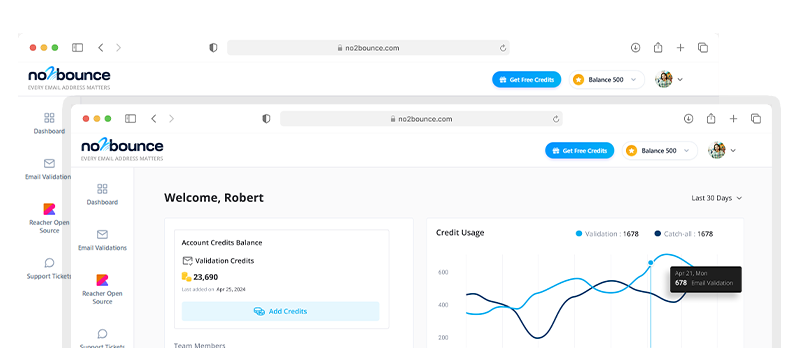
.jpg)
Catch-all domains accept every inbound email, valid address or not, and that single configuration decision creates a verification nightmare for outbound sales teams. When your email verification tool flags these addresses as "accept-all," you're left with a frustrating binary. You can send to them and risk bounces, or skip them and leave a significant portion of your prospective pipeline untouched.
The scale of the problem is real. Industry estimates consistently place catch-all addresses at 20–40% of B2B email lists, depending on the vertical and region. That's not a rounding error. It's a substantial slice of your total addressable market that conventional verification simply cannot resolve with confidence.
Here's what makes this particularly costly for outbound teams:
- Hard bounces from undeliverable catch-all addresses push your sender reputation below safe thresholds, triggering spam filters across your entire domain.
- False negatives, where risky addresses get treated as valid, inflate your "verified" list while quietly eroding deliverability rates over time.
- Skipped catch-alls mean your personalized outreach never reaches decision-makers sitting behind corporate Microsoft 365 or Google Workspace environments.
The core difficulty is technical. Most verification services rely on SMTP handshake responses to confirm deliverability, but catch-all servers return a "250 OK" for every address regardless of whether the mailbox exists. Without deeper behavioral analysis that simulates actual delivery patterns across multiple server interactions, a standard verification pass tells you almost nothing useful.
Understanding which tools actually solve these matters before you make a purchasing decision. That starts with the vocabulary, so let's define the terminology that separates genuine catch-all resolution from marketing noise.
If your current verification workflow treats catch-all addresses as a binary pass/fail, you're almost certainly leaving deliverability and pipeline on the table.
Essential Terminology for Email Validation
Before evaluating any service, it's worth establishing a shared vocabulary. Misunderstanding even one term, such as the difference between "catch-all" and "invalid," can lead to the wrong tool choice and a damaged outbound pipeline.
Key terms every practitioner should know:
- Catch-all domain: A mail server configured to accept messages sent to any address at that domain, regardless of whether the mailbox exists. The domain won't reject the verification probe, making standard checks unreliable.
- Hard bounce: A permanent delivery failure, meaning the address definitively doesn't exist. Hard bounces above 2% signal deliverability problems to inbox providers.
- Soft bounce: A temporary failure, often due to a full mailbox or a server being offline. These addresses may be valid; they simply weren't reachable at that moment.
- Risky / accept-all: A classification applied to addresses on catch-all domains where existence can't be confirmed or denied through a standard SMTP handshake.
- Deep verification: A method that goes beyond the initial SMTP check, analyzing server behavior patterns, historical send data, and domain reputation signals to assign a more reliable deliverability probability to catch-all addresses.
- Bounce rate threshold: Most UK B2B data providers and outbound sales practitioners treat a 5% hard bounce rate as the ceiling before sender reputation degrades meaningfully.
Standard "valid/invalid" binary outputs break down entirely on accept-all domains. A tool that returns only those two states will classify every catch-all address as "risky" and leave you flying blind on a portion of your list that, in B2B outreach, can represent 20–40% of total contacts.
The right terminology isn't just academic. It directly determines which verification features you should demand before purchasing any service.
Head-to-Head: Top Catch-All Verification Services Compared
Not every service delivers the same depth of analysis on a list heavy with catch-all domains. The distinction between "unverifiable" and "risky" maps directly onto how these tools are architected.
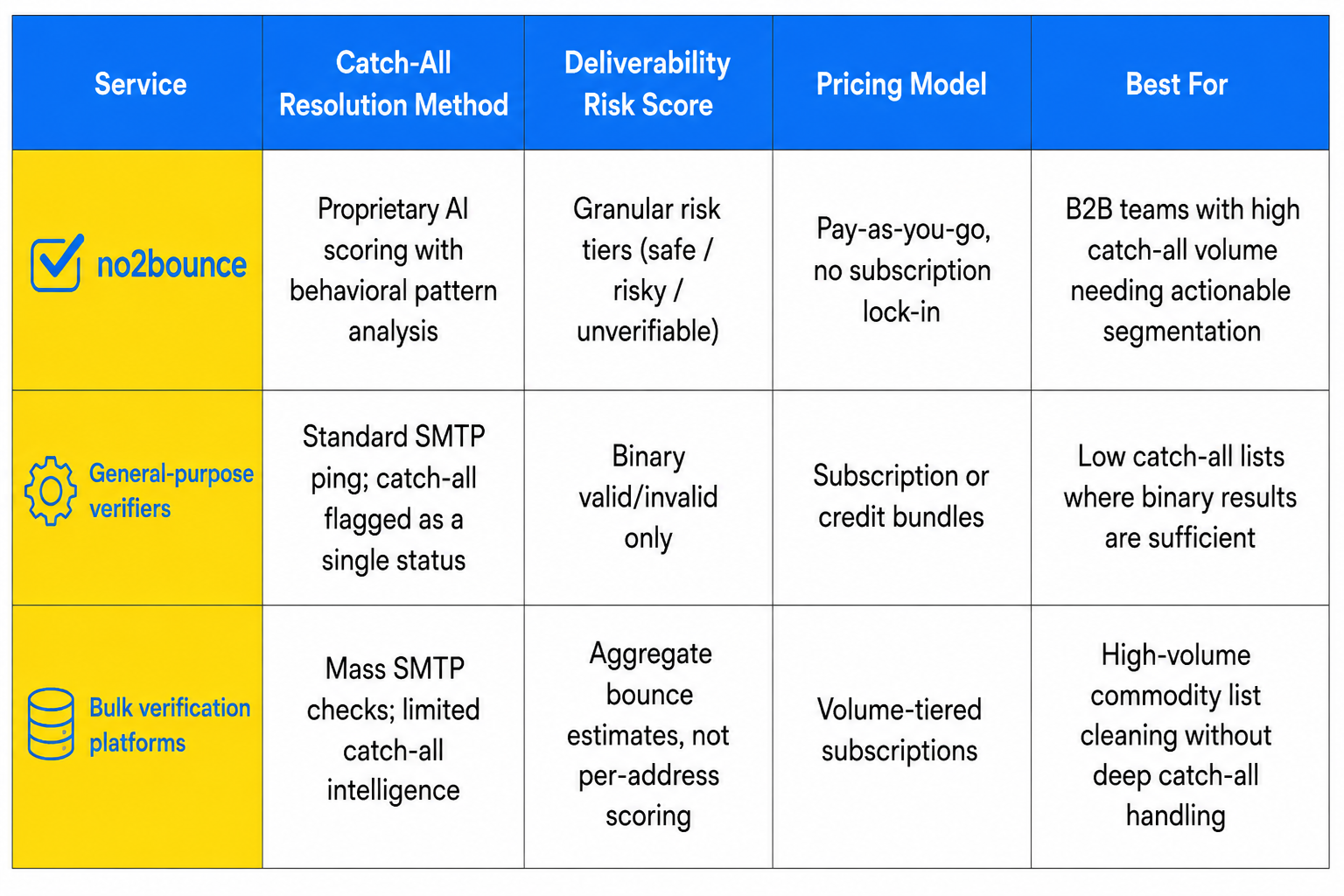
The critical differentiator is whether a service treats catch-all as a dead end or as a starting point for deeper analysis. General-purpose tools flag an entire catch-all domain uniformly, leaving you to either skip every address or accept the full bounce risk, and neither outcome supports a healthy outbound deliverability strategy.
Choose a service with granular catch-all scoring if your contact lists include a meaningful percentage of corporate domains, which commonly run catch-all configurations. Choose a standard bulk verifier only if your lists are predominantly consumer addresses, where catch-all domains are rare and binary verification is sufficient.
The right evaluation criterion isn't price per credit. It's how precisely a service resolves the addresses your competitors are ignoring.
Deep Dive: ZeroBounce and the AI Scoring Model
The ZeroBounce vs. MillionVerifier debate is one of the most common evaluation points practitioners encounter when building an outbound pipeline. Both tools address catch-all validation, but through fundamentally different architectures, and those differences matter when your sender reputation is on the line.
ZeroBounce applies a proprietary AI scoring model that assigns a deliverability confidence score to each address, including catch-all addresses that standard verifiers simply flag and abandon. Rather than returning a binary result, it layers behavioral signals, domain history, and mail server response patterns into a numeric score. In practice, this gives outbound sales teams a ranked list they can segment. High-confidence catch-alls go into active sequences, mid-range scores get deprioritized, and low-confidence addresses stay out of the sending pool entirely. Protecting sender reputation depends on exactly this kind of graduated decision-making, not blanket suppression.
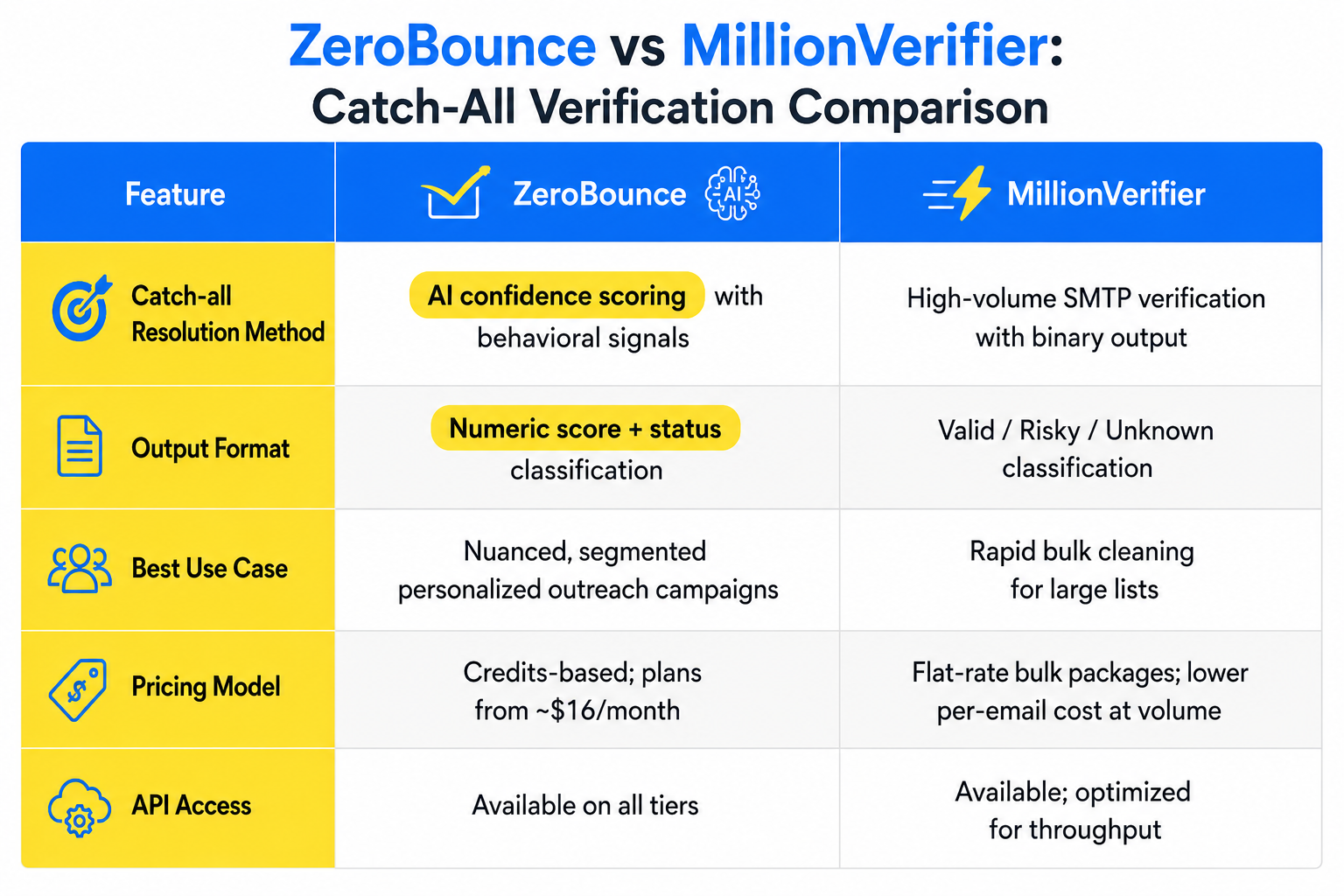
Choose ZeroBounce if your AI SDR workflows depend on granular segmentation and you need scored data to inform outreach prioritization. Choose MillionVerifier if raw throughput and cost-per-verification are the primary constraints. Where no2bounce fits into this comparison, and where it differs from both, is covered later in this guide.
Score your catch-all addresses rather than suppressing them wholesale, and your outbound pipeline will deliver higher engagement with meaningfully less bounce risk.
MillionVerifier: The High-Volume Choice for SEO Agencies
Shifting from AI-driven scoring to a high-volume context, a different set of priorities emerges, including throughput, cost per verification, and whether bulk processing speed justifies the accuracy trade-off.
For SEO agencies managing client outreach at scale, the decision between bulk-optimized tools like MillionVerifier and more specialized services like no2bounce often comes down to list composition and acceptable risk thresholds.
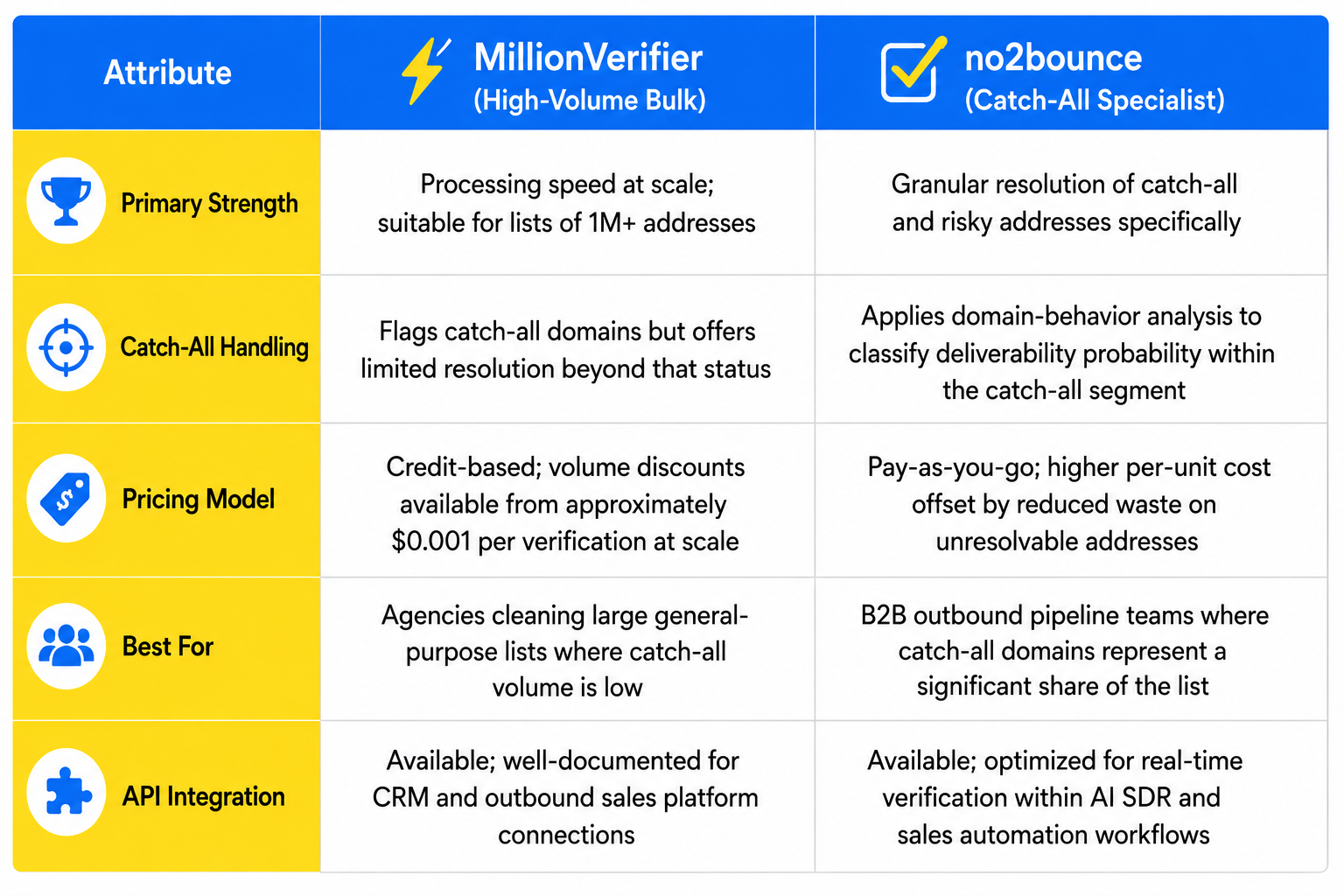
High-volume bulk tools serve a clear purpose. When a list is primarily standard domains and catch-all addresses are a small fraction, processing speed and lower unit cost make them the rational choice. That said, catch-all addresses in B2B lists frequently account for 20–40% of contacts, a proportion high enough that bulk-only treatment leaves material deliverability risk unaddressed.
For agencies juggling multiple B2B clients, where sender reputation issues on one account can spill into how all your campaigns are perceived, that distinction matters more than the per-credit price tag suggests.
Pick a high-volume bulk tool if your lists are large, your catch-all proportion is low, and cost-per-verification is the primary constraint. Choose a catch-all specialist if B2B data is central to your outbound sales motion and domain-level resolution is non-negotiable.
The right tool for catch-all validation isn't the fastest one. It's the one that resolves the addresses your outbound pipeline actually depends on.
no2bounce: The Modern Alternative for Deliverability Protection
Where ZeroBounce and MillionVerifier represent AI-driven scoring and high-volume processing respectively, no2bounce occupies a distinct position. It's purpose-built around catch-all resolution as a primary function, not an afterthought. For outbound sales teams and B2B data providers who treat catch-all validation as mission-critical, this specialization matters.
The core differentiator is no2bounce's Enhanced Catch-All Verification protocol. Rather than returning a blanket "catch-all" status and leaving the decision to the sender, the system performs extended behavioral analysis on catch-all domains, simulating delivery handshakes and monitoring server response patterns, to assign a granular risk score. Addresses that would be marked unverifiable by generic tools get resolved into actionable segments such as safe-to-send, risky, or block. For teams running personalized outreach at scale, that distinction directly protects sender reputation.
Catch-all addresses routinely constitute 20–40% of a typical B2B list, meaning generic verification leaves a significant portion of any outbound pipeline unresolved.
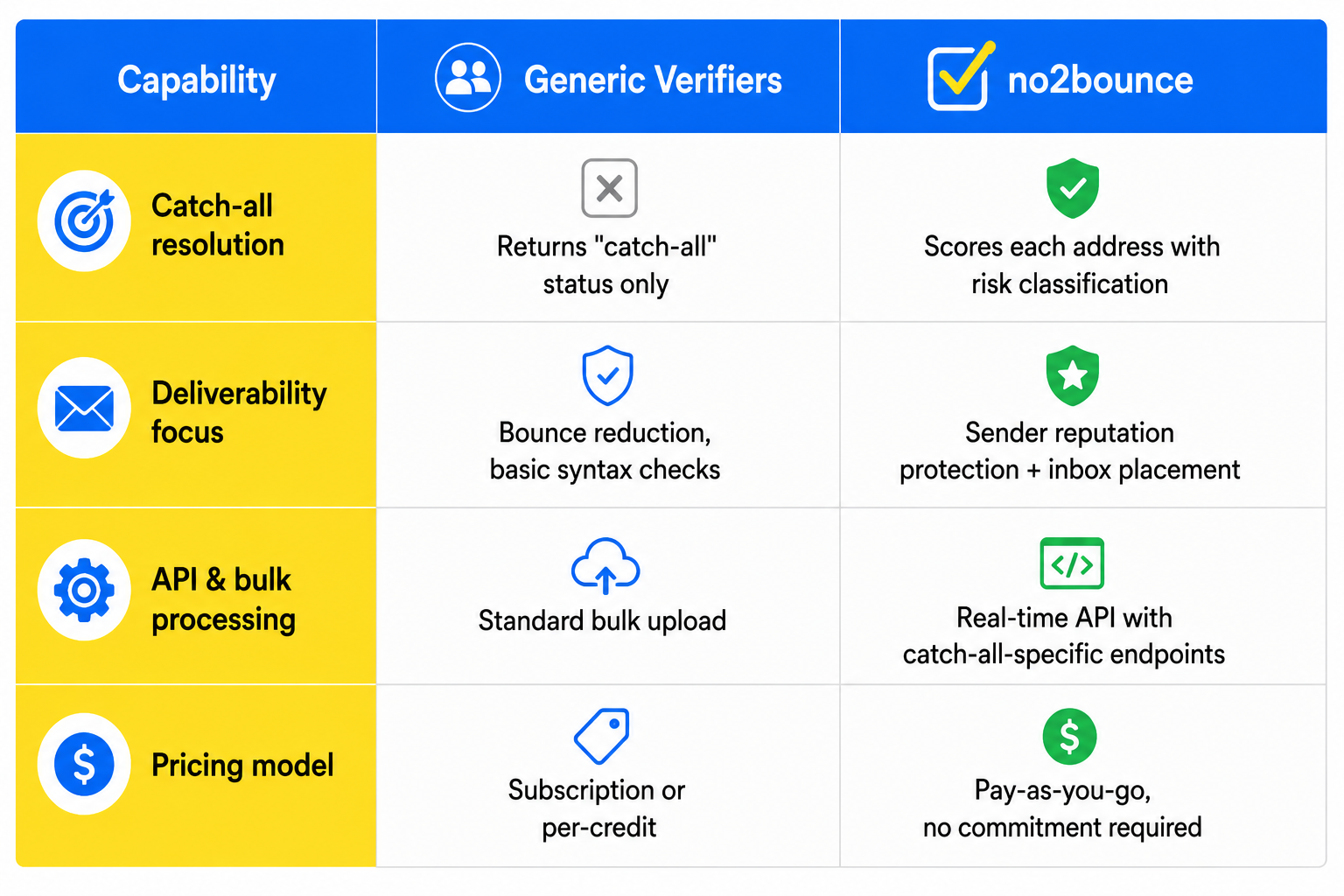
Pick a generic verifier if catch-all addresses are a small fraction of your list and basic bounce reduction satisfies your requirements. Choose no2bounce if catch-all domains represent a meaningful share of your B2B contacts and protecting sender reputation is non-negotiable for your outbound pipeline.
Understanding what no2bounce classifies as "risky" is only half the equation. The next challenge is deciding what to do with those addresses safely.
The Pro Strategy: How to Safely Send to Catch-All Addresses
Choosing the best catch-all email verifier is only half the equation. How you act on the results determines whether your outbound pipeline stays healthy or your sender reputation takes a hit.
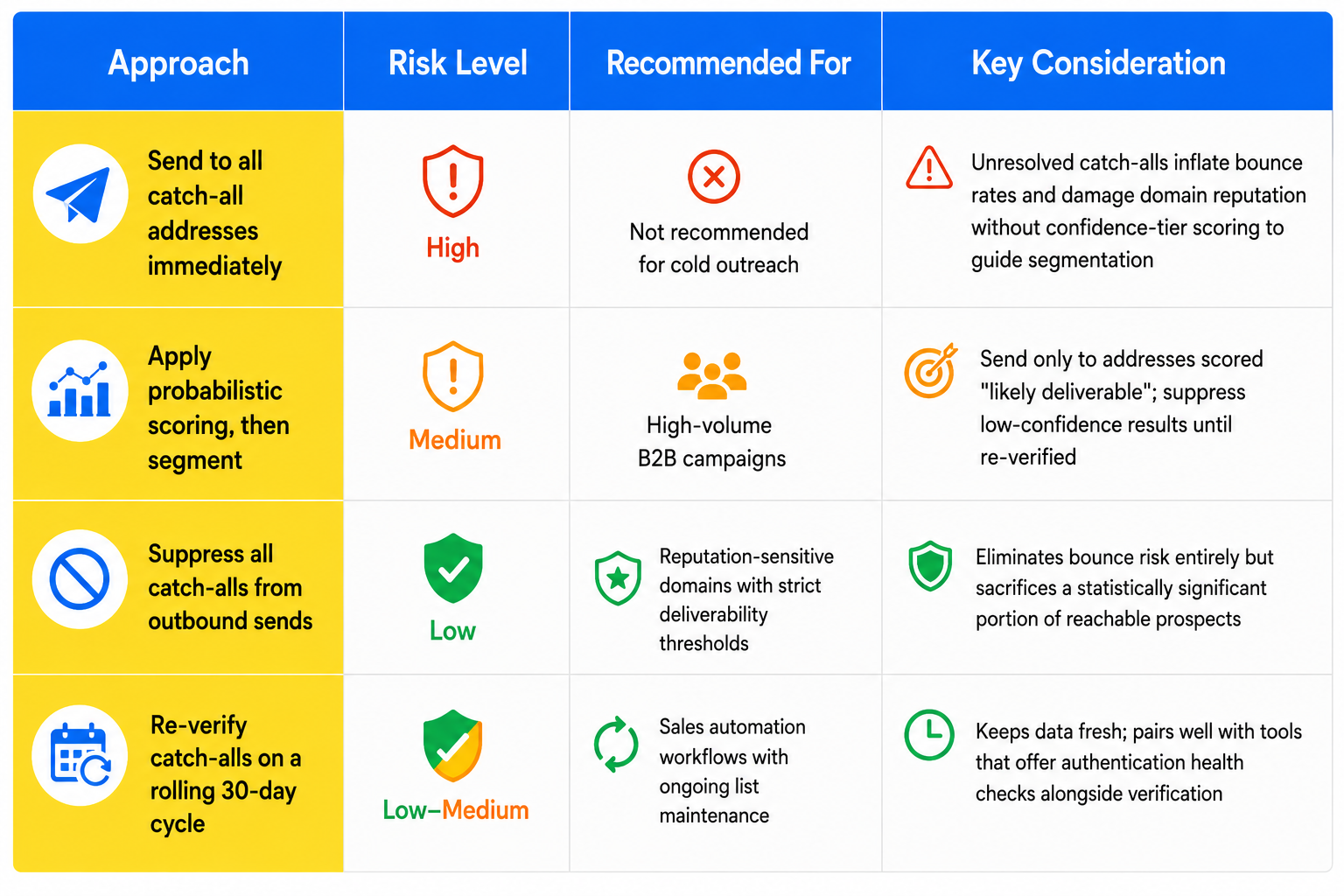
Segmentation is the professional standard, not suppression. Outbound teams that apply probabilistic confidence tiers, sending to high-confidence catch-alls, warming mid-confidence addresses gradually, and suppressing low-confidence results, consistently protect deliverability without abandoning reachable contacts. Teams that combine verification scoring with ongoing authentication monitoring tend to see lower bounce rates than those relying on binary valid/invalid outputs alone.
One practical approach is to review catch-all verification insights alongside your existing deliverability troubleshooting process, treating list hygiene and inbox placement as a single workflow rather than separate tasks.
The right strategy isn't about avoiding catch-all addresses. It's about knowing exactly which ones are worth sending to, and acting on that intelligence with precision before your next send.
Key Takeaways: Choosing the Right Verifier for Your Workflow
Selecting the best catch-all email verifier comes down to three variables. These are your outbound volume, your tolerance for bounce risk, and how deeply you need verification integrated into your sales automation stack.
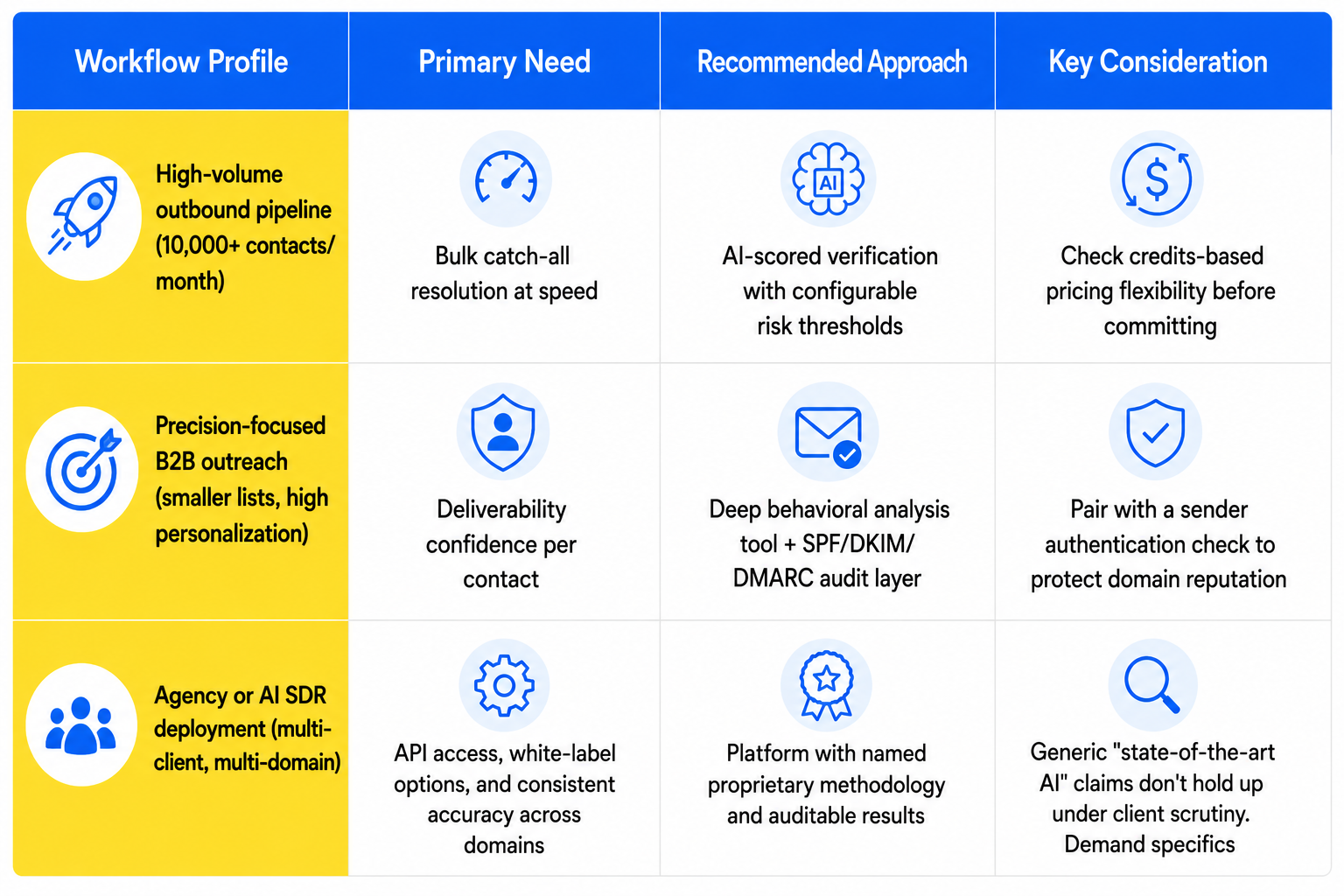
No single tool wins every scenario. Accuracy and feature depth vary enough across services that workflow fit matters as much as raw performance metrics.
- For volume-first teams. Prioritize throughput, risk scoring, and CRM integration.
- For deliverability-first teams. Prioritize domain authentication analysis alongside catch-all resolution.
- For AI SDR workflows using tools like AiSDR or 27x.ai, demand verifiable technical methodology, not marketing language.
The right verifier isn't the one with the most features. It's the one that protects your sender reputation while keeping your outbound pipeline moving.
Start cleaning your list instantly.
No credit card required.