.jpg)
But "spam trap" isn't one thing: it's a category, and the type you hit tells you exactly what's broken in your list-building process.
This guide breaks down the two core spam trap types, pristine and recycled, plus the related typo trap, so you understand not just what they are, but why they exist and what hitting one actually signals to mailbox providers.
If you're comparing tools to catch these before you send, see our guide to the best spam trap checkers; this article is the fundamentals behind it.
What Is a Spam Trap?
A spam trap is an email address that isn't monitored by a real person and exists specifically to catch senders with poor list hygiene or non-consensual collection practices. It looks like an ordinary inbox to your sending system, but no human ever opens it, clicks it, or opts into anything from it.
Mailbox providers, blocklist operators (like Spamhaus), and dedicated deliverability vendors seed and monitor these addresses. When a trap receives mail, it's treated as strong evidence that the sender is either scraping addresses, buying lists, or failing to remove dead contacts, and that evidence feeds directly into sender reputation scoring.
Every trap type shares that basic mechanic. What differs is how the address was created, and that difference is the whole story.
Pristine Spam Traps
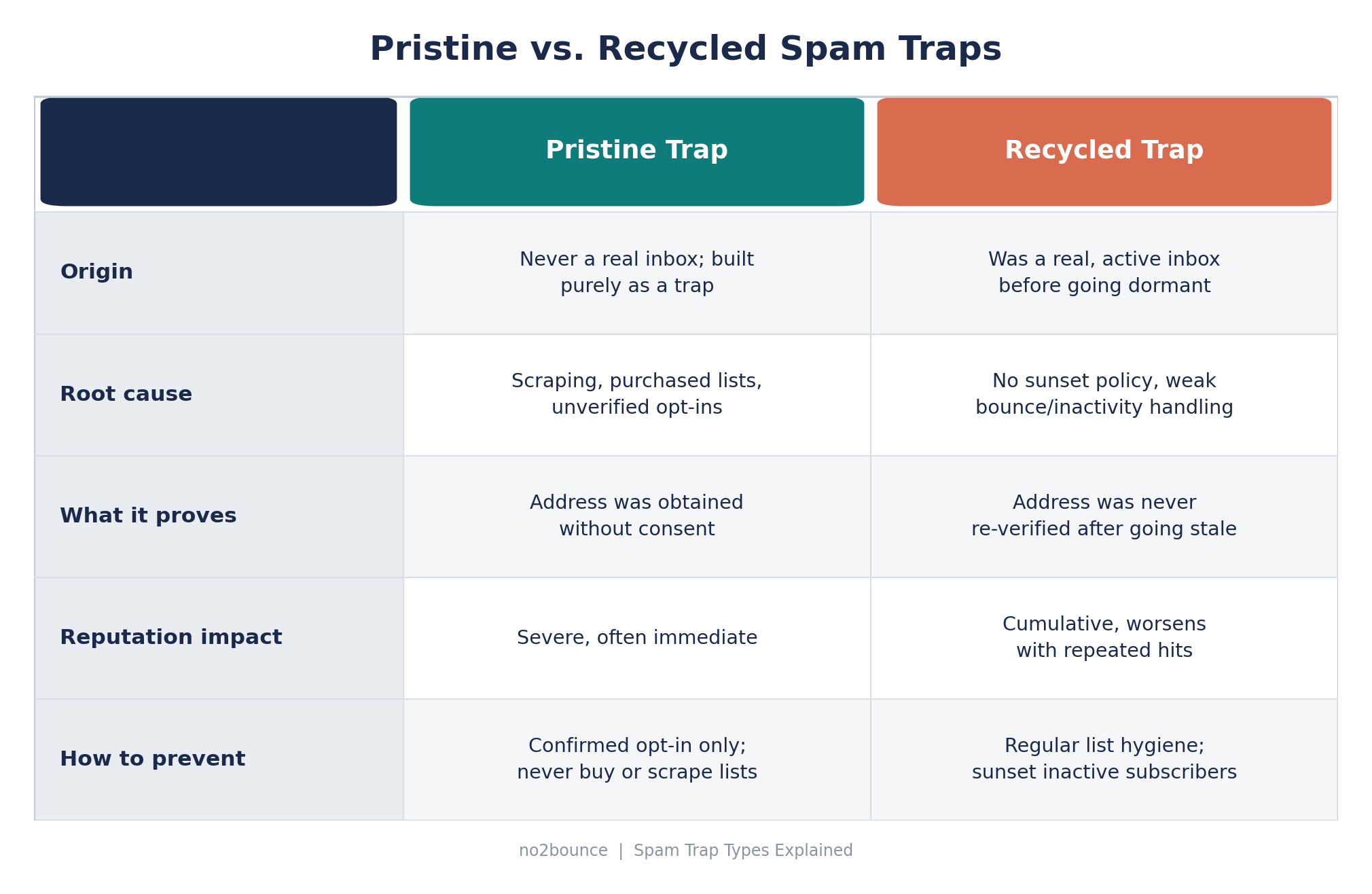
A pristine spam trap (sometimes called a "pure" or "honeypot" trap) is an address that never belonged to a real person. It was manufactured for one purpose: to catch senders who never had permission to email it in the first place.
How they're created and seeded:
- Planted in hidden HTML on public web pages, where only scrapers and bots would find them
- Inserted into old, unmaintained forums, directories, or comment sections
- Slipped into purchased or "co-registration" lists that get resold repeatedly
Because a pristine trap was never opted in anywhere, there is no legitimate scenario where a well-run list acquires one. That's what makes it so dangerous: hitting a pristine trap doesn't suggest neglect, it suggests your addresses came from scraping, purchasing, or unverified sign-up forms with no confirmation step.
What it signals: an acquisition problem, how the address got onto your list in the first place.
Typical consequence: severe and fast. A single pristine trap hit can trigger domain or IP blocklisting, since it's read as near-certain proof of non-consensual collection.
Recycled Spam Traps
A recycled spam trap was once a real, active inbox. Someone opted in, used it, and then abandoned it. The account was closed, the employee left the company, or the person simply stopped checking it. After a sustained period of inactivity, the mailbox provider repurposes the dormant address into a trap.
How they end up on your list:
- Contacts added a year or more ago who were never re-verified
- No sunset policy for subscribers who stop opening or clicking
- Weak bounce handling that keeps dead addresses active instead of suppressing them
Recycled traps signal something different from pristine ones: not how you got the address, but how long you kept mailing it without noticing it went dark.
What it signals: a retention and hygiene problem, stale contacts sitting in an unmaintained list.
Typical consequence: generally less severe per hit than a pristine trap, but repeated hits still erode sender reputation over time and point to a systemic hygiene gap rather than a one-off mistake.
Pristine vs. Recycled: Side-by-Side
A Third Type: Typo Traps
Most deliverability teams also track a third category worth knowing, since it's easy to confuse with the two above:
Typo traps are common misspellings of real domains, such as “gmal.com” or “hotnail.com”, registered by trap operators because so many people mistype their own email address at signup. These point to a different failure entirely: weak input validation on your sign-up forms, not scraping or stale data.
Why the Distinction Actually Matters
Knowing which trap type you hit tells you exactly where to focus your fix:
- Pristine hit → audit your acquisition sources. Stop scraping, stop buying or renting lists, and require double opt-in confirmation on every form.
- Recycled hit → audit your retention process. Build a sunset policy for subscribers who haven't opened or clicked in 6–12 months, and suppress hard-bounced addresses immediately rather than retrying them.
- Typo hit → audit your form validation. Add real-time syntax and domain checks at the point of entry.
Treating all three the same way, just "cleaning the list" without knowing why addresses went bad, means the same problem resurfaces on your next campaign.
How to Keep Both Trap Types Out of Your List
- Never buy, rent, or scrape email lists. This is the single biggest driver of pristine trap hits.
- Use confirmed (double) opt-in so every address on your list has proven it belongs to a real, consenting person.
- Validate addresses before they're stored: catching syntax errors and risky domains at signup prevents typo traps from ever entering your database.
- Run a regular sunset policy that removes or re-permissions subscribers who've gone quiet for an extended stretch, so dormant addresses don't sit there long enough to be recycled into traps.
- Screen your list against a spam trap database before sending, especially after importing an old list, acquiring another company's contacts, or reactivating a dormant segment.
That last step is where a dedicated spam trap checker earns its place in your workflow. See our comparison of the best spam trap checkers for how to evaluate one.
FAQ
Can I tell if I've hit a spam trap?
Not directly. Trap addresses don't reply or unsubscribe, so there's no built-in signal. The first clue is usually a sudden, unexplained drop in inbox placement or a blocklist notice. That's why proactive list screening matters more than after-the-fact detection.
Do spam traps ever expire?
Recycled traps can eventually be retired by the mailbox provider, but there's no public schedule for this, and pristine traps generally don't expire at all. The safest approach is prevention, not waiting them out.
Is one hit enough to get blocklisted?
It depends on the trap type and vendor. A single pristine trap hit from a well-known trap network can be enough to trigger action; recycled trap hits usually need to accumulate before they cause serious damage, though they still count against you.
Want to check a list before you send? Run it through no2bounce to catch invalid, risky, and trap-flagged addresses before they hit your sender reputation.
Start cleaning your list instantly.
No credit card required.