
Most holiday email campaigns are lost in September, not in November.
Here is the pattern. A list sits mostly untouched from January onwards. Engagement drifts. Addresses go stale. Then in the last week of November, that list gets hit with four or five times its normal sending volume, all at once, all promotional.
Mailbox providers read that as unfamiliar behaviour. Deliverability drops in the week that matters most, and the post-mortem blames the subject lines.
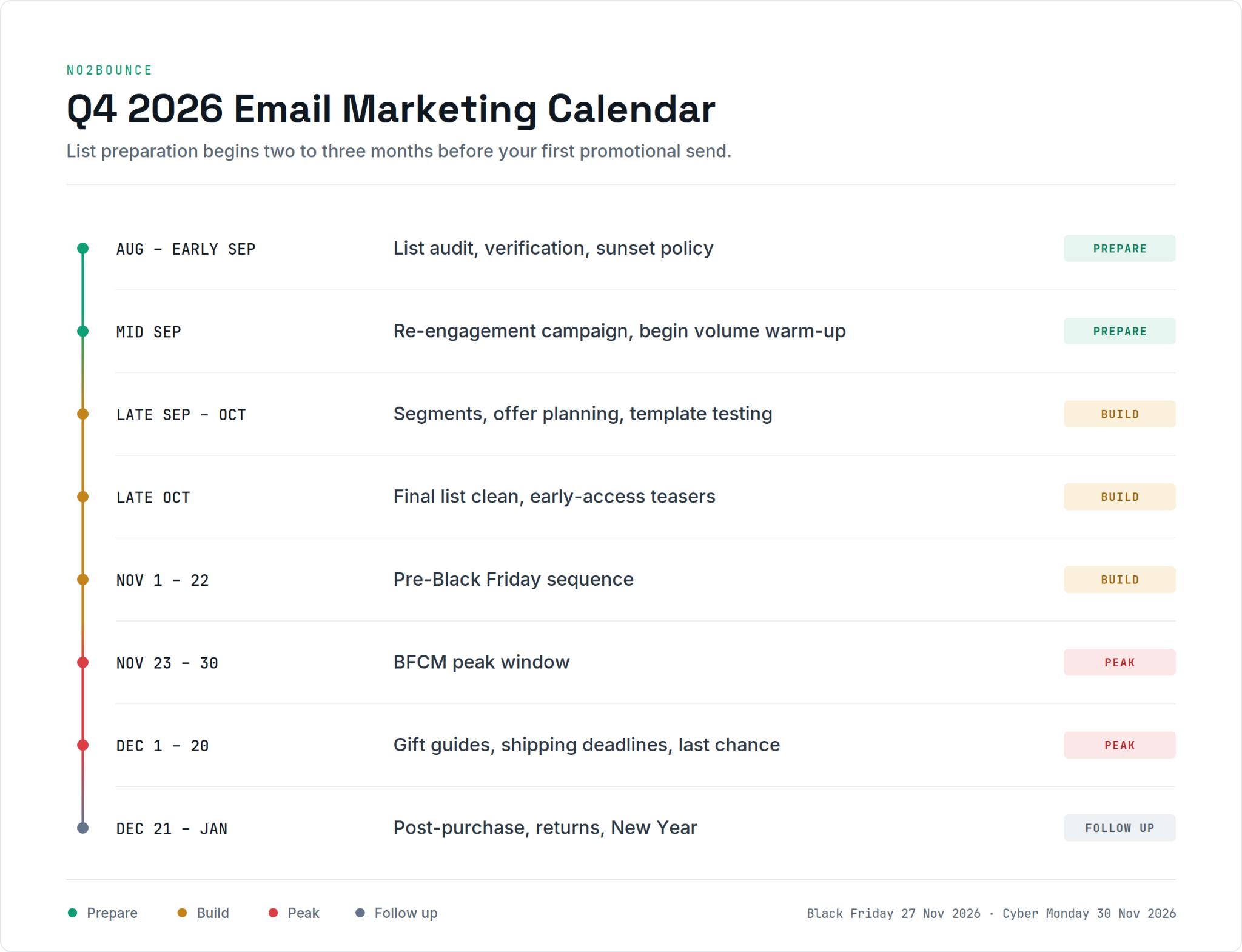
This is a dated plan rather than a list of tips. It covers what to do in each phase of Q4 2026, why the timing matters, and what breaks when a phase gets skipped. Black Friday falls on 27 November 2026, with Cyber Monday on 30 November, and the schedule below works back from there.
Quick answer: the Q4 email timeline
- August to early September — audit and verify your list, set a sunset policy
- Mid September — run re-engagement, begin warming up sending volume
- Late September to October — build segments, plan offers, test templates
- Late October — final list clean, early-access teasers
- November weeks 1 to 3 — pre-Black Friday sequence
- BFCM week — peak sends
- 1 to 20 December — gift guides, shipping deadlines, last chance
- 21 December onwards — post-purchase, returns, New Year
The recurring theme is that list preparation happens two to three months before the first promotional send, not the week before.
Why holiday email campaigns fail, and it is rarely the copy
Four things go wrong in Q4, and all of them are structural rather than creative.
Dormant lists
Addresses collected during last year's season that have had no contact since are the biggest single liability. Mailbox providers weight recent engagement heavily. When a subscriber has not opened, clicked or replied in twelve months, a sudden promotional send has very little positive signal behind it.
The problem compounds. Low engagement leads to more inbox placement in the promotions tab or spam folder, which produces even lower engagement, which further weakens your sender reputation heading into your highest-volume week.
Recycled spam traps
Some abandoned addresses get repurposed by mailbox providers as recycled spam traps. There is no way to identify these by looking at a list, and no warning before you hit one.
The exposure scales with how long a list has been sitting untouched. A list that was last cleaned before the 2025 season carries meaningfully more risk than one cleaned in the last quarter. Running a bulk email verification pass removes invalid and long-abandoned addresses before they cost you.
Volume spikes
Going from 5,000 sends a month to 50,000 in a single week is a pattern that looks more like a compromised account than a campaign. Mailbox providers respond with throttling and deferrals, which means your Black Friday send may still be trickling out on Saturday.
This is fixable, but only with lead time. Volume needs to ramp over several weeks, which is why the warm-up starts in September.
Complaint pressure
Promotional frequency rises sharply in Q4 across every sender, which raises complaint rates across the board. Your own margin for error narrows at exactly the moment you are sending more than usual.
Complaint rates are also slow to recover from. A bad week in late November can affect placement well into the new year.
The Q4 2026 email marketing calendar
August to early September: audit and clean
Export your full list and look at it honestly. How many addresses have had any engagement in the last six months? How many were collected more than a year ago and never contacted since?
Run verification across the whole list at this point rather than in November. Doing it now means you have time to act on what you find, and time to rebuild volume if the clean removes a large share of your file.
Define your sunset policy in the same pass. Decide what counts as dormant for your business and what happens to those contacts.
Mid September: re-engage and start warming up
Send your re-engagement campaign now. This is the single most commonly mistimed activity in Q4. A win-back sent in November adds unpredictable risk during the week you can least afford it, because you are deliberately mailing your least engaged segment at peak volume.
Sent in September, the same campaign is low stakes. Anyone who responds joins your engaged segment in time for the season. Anyone who does not gets suppressed with two months to spare.
Begin the volume ramp in parallel. Details below.
Late September to October: build the campaigns
With the list settled, build segments on data you can trust: purchase history, engagement recency, product category, location. Segmenting a list you have not cleaned means building on records that will not survive the season.
Plan offers, write templates and test rendering across clients now. October is also when you should test any new automation flows, because a broken abandoned cart trigger discovered on 27 November is not recoverable.
Late October: final clean and early access
Run one more verification pass over anything added since the first clean, particularly addresses collected through forms and lead magnets.
Send early-access or teaser campaigns to your most engaged segment only. This does two useful things: it gives your best customers a reason to stay subscribed through the noise, and it generates fresh engagement signal immediately before your heaviest sends.
November 1 to 22: the run-up
Build frequency gradually rather than jumping straight to daily sends. Move engaged segments first and less engaged segments later, so that your early November sends carry the strongest signal.
Keep an eye on bounce and complaint rates through this period. If either climbs, slow down. It is better to send less in the run-up than to enter BFCM week with a damaged reputation.
November 23 to 30: BFCM week
Your heaviest sending window. A workable pattern is an early-access send on the Monday or Tuesday, the main announcement on Black Friday morning, a mid-weekend reminder, and Cyber Monday as a separate offer rather than a repeat.
Send to your most engaged segments at the highest frequency and taper for everyone else. Blanket sending to your entire file every day of this week is where complaint rates spike.
December 1 to 20: the second half
Black Friday gets the attention, but December carries a long tail. Gift guides work throughout. Shipping deadline reminders are among the highest-converting sends of the season because they carry genuine, non-manufactured urgency.
Plan a clear last-chance send tied to your actual shipping cutoff, and a follow-up for digital or gift card options after the cutoff has passed.
December 21 onwards: the part most brands skip
Post-purchase sequences, returns and exchange information, and a January re-engagement push for everyone who bought during the season but has not been contacted since.
This is also the moment to clean the addresses you acquired during Q4, while they are fresh, rather than letting them sit until next August.
Preparing your list before peak season
Verify before you segment
Clean first, then segment. Building segments on an unverified list means your logic is running against records that will bounce, and your engagement rates are being calculated against a denominator that includes dead addresses.
Set a sunset policy
Decide what dormant means for your business. Twelve months with no opens or clicks is a common threshold, though it varies by purchase cycle. A business selling annually replaced products will have a different definition than one selling weekly consumables.
Suppressing dormant contacts feels like losing reach. In practice you are removing addresses that were not going to convert and were actively working against your placement for the ones that would.
Re-engage in September, not November
Covered above, but worth repeating because it is the most common sequencing error. Win-back campaigns are inherently risky sends. Run them when a poor result costs you nothing.
Warm up your sending volume
If your Q4 peak is significantly above your normal monthly volume, ramp towards it. As an illustration of the shape rather than a prescription, a sender moving from 10,000 to 50,000 monthly sends might build across six weeks:
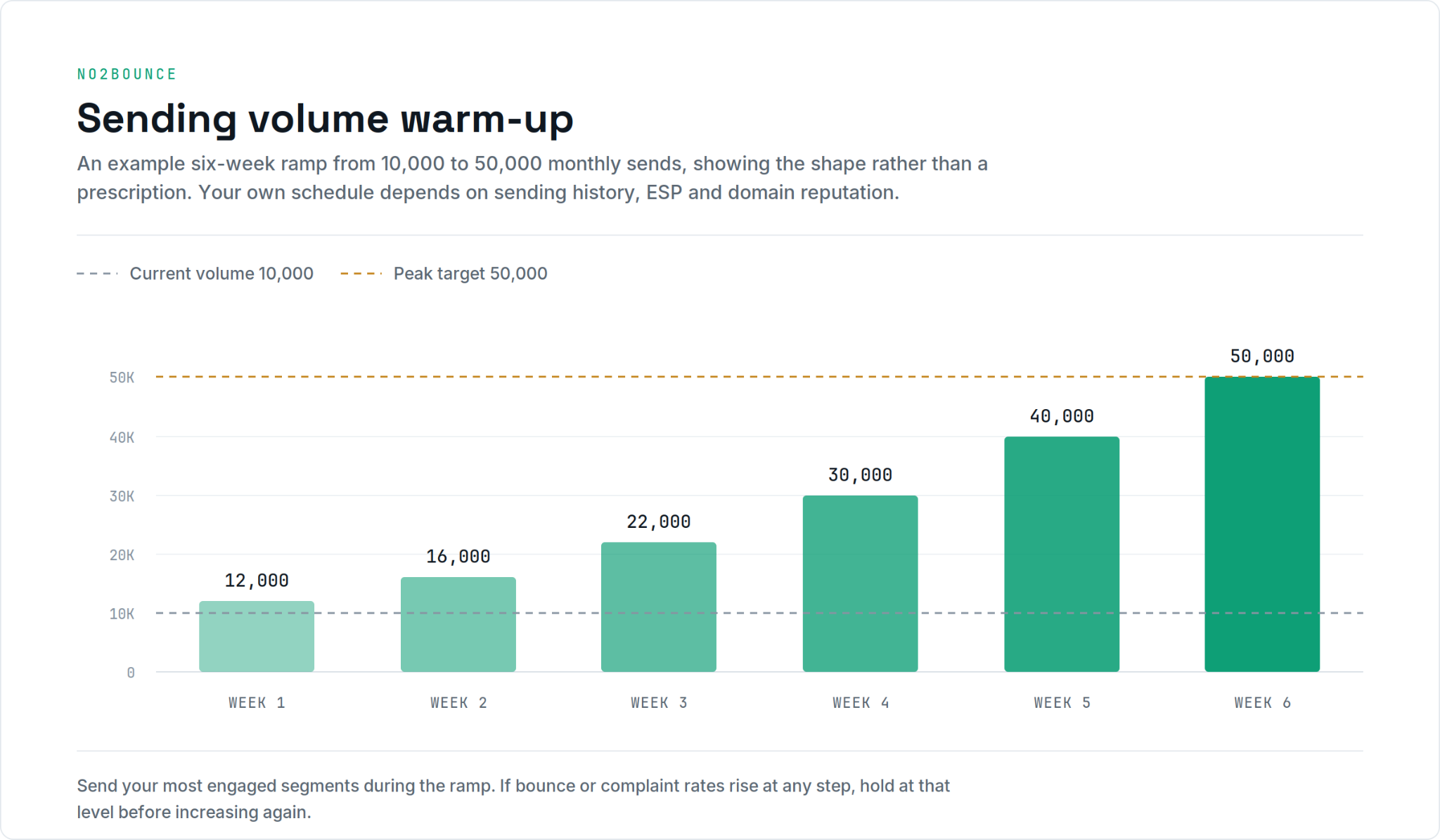
Your own ramp depends on your sending history, your ESP and your domain reputation. The principle holds regardless: increase in steps, send your most engaged segments during the ramp, and watch bounce and complaint rates at each step. If either rises, hold at the current level before increasing again.
Checking your sender reputation before you start gives you a baseline to measure the ramp against.
Check authentication before October
Confirm SPF, DKIM and DMARC are configured and aligned. This is a one-time fix with a long payoff, and it is far easier to sort out in September than to diagnose mid-campaign.
If you are unsure where you stand, an email deliverability check will surface configuration issues alongside your current placement.
Campaign types worth building
- Gift guides — work from late October through mid December, and segment well by past purchase category
- Early access — for engaged subscribers only, sent before your public announcement
- Abandoned cart with seasonal urgency — higher intent than usual in Q4, and shipping deadlines give the urgency a real basis
- Shipping deadline reminders — genuine urgency, consistently strong performers
- Last chance — one clear send tied to your actual cutoff, not three
- Post-purchase and returns — lowest effort, most neglected, and useful for retention into January
Subject lines that earn the open
Black Friday
- Early access opens tonight
- Your Black Friday list, sorted by what you actually bought last year
- 30% off, no code needed
- We only do this once a year
- Black Friday ends at midnight
- Still deciding? Here is what is nearly gone
- The three things worth buying today
- Cyber Monday, different offer
What works in this set is specificity and honesty. Vague urgency reads as noise in a week when every inbox is full of it. A named discount, a real deadline or a reference to something the subscriber actually did will outperform another "don't miss out."
Christmas
- Order by Thursday for delivery before Christmas
- Gifts under £50 that are not candles
- Last posting date is tomorrow
- Still on your list?
- Digital gift cards, delivered instantly
- The guide for people who are difficult to buy for
- Everything ships free this week
- Missed the cutoff? There is still an option
What to avoid
Spam filter pressure is higher in Q4 because promotional volume is higher. All-caps subject lines, excessive punctuation, and the standard trigger vocabulary carry more cost than usual. So does false urgency: a "final hours" subject followed by another send tomorrow trains subscribers to ignore you and raises complaint rates at the worst possible moment.
After the season ends
Returns and exchange information should go out proactively rather than waiting for support tickets. Send a January re-engagement to your Q4 buyers before they go cold, since a customer who bought in November and hears nothing until March is a customer you will be winning back next year.
Record what happened while it is fresh. Which segments performed, which sends drove complaints, where the volume ramp caused problems. Next year's plan is much easier to write with this year's numbers in front of you.
Then clean the addresses you collected during the season. Q4 sign-ups include a high proportion of one-time discount hunters and mistyped addresses, and cleaning them in January is far cheaper than discovering them next November.
Common Q4 email mistakes
- Cleaning the list in November instead of September
- Sending a re-engagement campaign during peak season
- Jumping to peak volume with no warm-up
- Mailing the entire file at the same frequency all week
- Discovering a broken automation on Black Friday morning
- Ignoring December after Cyber Monday
- Sending three separate "final hours" emails
- Leaving Q4 sign-ups uncleaned until the following year
Frequently asked questions
When should I start planning holiday email campaigns?
List preparation should begin in August or early September. Creative and campaign build can follow in October. The constraint is not the writing, it is the lead time needed to clean your list and warm up sending volume.
When should I send Black Friday emails?
For 2026, Black Friday falls on 27 November. A common structure is early access to engaged subscribers on the Monday or Tuesday, the main send on Black Friday morning, a weekend reminder, and Cyber Monday on 30 November as a separate offer.
How do I avoid the spam folder during the holidays?
Most of the work happens before you send: verify your list, suppress dormant contacts, warm up your volume gradually, and confirm SPF, DKIM and DMARC are aligned. Subject line hygiene matters, but it will not compensate for a stale list or a sudden volume spike.
Should I email subscribers who have not opened in a year?
Not during peak season. Run a re-engagement campaign in September, then suppress anyone who does not respond. Mailing a fully dormant segment in late November adds risk during your highest-stakes week.
How far ahead should I clean my email list?
Two to three months before your first major seasonal send, with a second pass in late October for anything collected since. Cleaning gives you time to act on the results and rebuild volume if a large share of the list is removed.
Getting your list ready
The creative side of holiday email marketing is the part everyone plans for. The part that decides whether any of it lands is usually settled months earlier, in how clean your list is and how carefully you build up to peak volume.
If your list has not been verified since the last season, that is the first job. Verify your list now and you have the full runway to act on what you find.
Start cleaning your list instantly.
No credit card required.