.png)
Bulk email verification has become essential infrastructure for organizations that rely on email marketing, lead generation, and automated outreach. Sending campaigns to invalid or risky email addresses can significantly increase bounce rates, damage sender reputation, and reduce inbox placement.
When comparing no2bounce vs NeverBounce, organizations typically evaluate verification accuracy, catch-all email detection, pricing structure, and scalability for processing large email lists.
Both platforms provide tools designed to clean email databases before campaigns launch. However, their verification methods, pricing models, and technical approaches differ in ways that may influence deliverability outcomes.
This guide examines both bulk email verification platforms across several practical dimensions:
- verification accuracy
- catch-all email detection
- pricing models
- API capabilities
- typical use cases for large email lists
Quick Answer: no2bounce vs NeverBounce
Both no2bounce and NeverBounce are bulk email verification platforms designed to remove invalid or risky email addresses from large contact lists before campaigns are sent.
- no2bounce focuses on scalable bulk verification, advanced catch-all email detection, and subscription-based pricing for high-volume senders.
- NeverBounce is an established verification platform that uses a pay-per-verification pricing model and is commonly used by marketing teams and agencies.
The best platform depends on verification volume, pricing preferences, and how important catch-all detection is for your campaigns.
What Is Bulk Email Verification?
Bulk email verification is the process of validating large lists of email addresses to determine whether they are capable of receiving messages.
Verification systems analyze several factors, including:
- email syntax correctness
- domain validity
- mail server configuration
- mailbox availability through SMTP verification
After these checks, email addresses are categorised into several results.
Deliverable
The mailbox exists and can receive messages.
Risky
The address may accept emails, but it contains potential issues such as disposable domains or role-based inboxes.
Catch-all
The domain accepts emails sent to any address, even if the mailbox does not exist.
Undeliverable
The mailbox does not exist, or the server rejects the message.
Bulk verification helps businesses maintain clean email databases and improve deliverability performance.
Key Email Verification Terms
Understanding common terminology helps organisations evaluate bulk verification tools more effectively.
Email Verification: Email verification is the process of determining whether an email address is valid and capable of receiving messages.
Email Validation: Email validation checks whether an email address follows the correct syntax and domain format.
Catch-All Email Address: A catch-all email address belongs to a domain configured to accept emails sent to any address under that domain.
Bulk Email Verification: Bulk email verification refers to validating large lists of email addresses simultaneously to remove invalid or risky contacts before sending campaigns.
These definitions help clarify how verification platforms classify email addresses during the validation process.
How Bulk Email Verification Works
Bulk email verification tools analyse email addresses through several verification layers.
1. Syntax Validation
The system checks whether the email address follows the correct structure.
Example format: username@domain.com
Incorrectly formatted addresses are immediately flagged as invalid.
2. Domain Verification
The verification system confirms that the domain exists and has active mail servers capable of receiving email.
3. SMTP Server Analysis
Verification platforms communicate with the domain’s mail server to determine whether the mailbox may exist.
4. Risk Detection
The system identifies addresses associated with disposable email services, temporary domains, or role-based inboxes.
5. Catch-All Detection
Advanced verification tools analyze server behavior to identify domains configured as catch-all email servers.
These steps help organizations filter invalid contacts before sending campaigns.
Example of Bulk Email Verification
Consider a marketing team preparing to send a campaign to a list of 100,000 email addresses.
Without verification, the list may contain:
- invalid email addresses
- outdated contacts
- catch-all domains
- disposable email accounts
If even 5–10% of the list is invalid, the campaign could generate thousands of hard bounces.
analyses
Using a bulk email verification platform such as no2bounce or NeverBounce, the system analyzes the list before sending and categorises addresses as:
- deliverable
- risky
- catch-all
- undeliverable
This allows marketers to remove problematic addresses and send campaigns only to valid recipients.
Overview of no2bounce and NeverBounce
Both no2bounce and NeverBounce are designed to help organizations maintain clean email databases.
no2bounce
no2bounce is built for scalable bulk email verification and emphasises accurate detection of catch-all email domains.
Key capabilities include:
- bulk email verification
- catch-all domain detection
- integrations with marketing and CRM platforms
NeverBounce
NeverBounce is an established email verification platform used by marketing teams and agencies to clean email lists and validate addresses during form submissions.
Key capabilities include:
- bulk email list cleaning
- real-time email verification API
- integrations with CRM and marketing tools
- validation reporting dashboards
Both platforms aim to reduce bounce rates and improve deliverability.
Accuracy and Verification Technology
Accuracy is the most important factor when comparing email verification tools.
Both platforms perform checks including:
- syntax validation
- domain verification
- SMTP communication
- mailbox existence analysis
The most significant differences appear when verifying catch-all domains.
Catch-all domains accept emails sent to any address under a domain. Because the server does not reject unknown mailboxes, verification tools must rely on behavioral analysis to determine whether addresses are deliverable.
no2bounce focuses heavily on detecting catch-all configurations and categorizing uncertain results more precisely.
NeverBounce also detects catch-all domains but may classify some results as unknown depending on server behavior.
Pricing Comparison
Pricing models differ significantly between the two platforms.
NeverBounce Pricing
NeverBounce operates on a pay-per-verification model.
Typical pricing ranges between:
- $0.008–$0.010 per email verification
- minimum credit purchases depending on plan size
This pricing model works well for organisations verifying email lists occasionally.
no2bounce Pricing
no2bounce uses a subscription-based or pay-as-you -go pricing structure, allowing organisations to verify large numbers of email addresses without paying per individual verification. For businesses verifying large lists regularly, subscription pricing can provide more predictable costs.
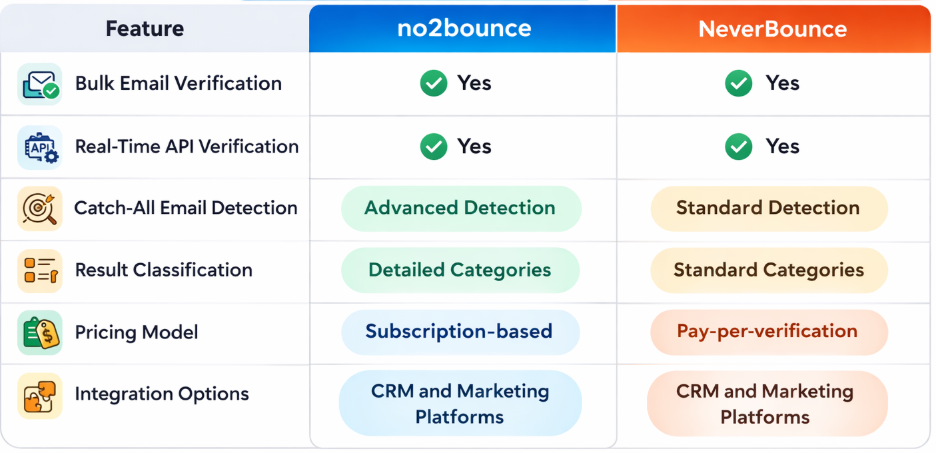
Feature Comparison
Organisations
Both platforms offer core email verification functionality, but their pricing models and catch-all detection capabilities differ.
Best Bulk Email Verification Tools in 2026
The bulk email verification market includes several platforms designed to clean large email lists before campaigns launch.
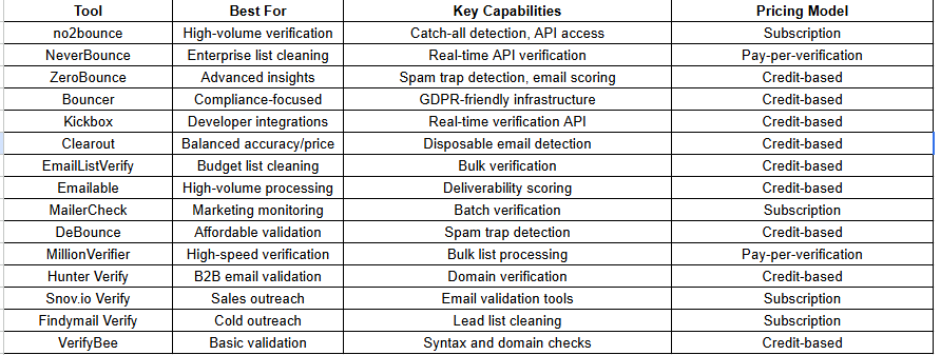
While many tools claim accuracy rates above 98%, actual performance depends on domain configurations and catch-all detection capabilities.
Best Use Cases for no2bounce and NeverBounce
Choosing between the platforms depends on operational needs.
When NeverBounce Is a Good Fit
NeverBounce is commonly used by:
- Marketing agencies managing multiple clients
- Organisations verifying moderate email volumes
- Teams requiring simple validation workflows
When no2bounce Is a Good Fit
no2bounce is often used by:
- Businesses sending high-volume campaigns
- B2B lead generation teams
- Organisations dealing with catch-all domains
- Marketing teams seeking predictable verification costs
Expert Insight
When evaluating bulk email verification platforms, the most important factor is not the advertised accuracy rate but how each system handles uncertain results such as catch-all domains. In high-volume email campaigns, even small accuracy differences can significantly impact deliverability and sender reputation.
Key Takeaways
- Bulk email verification helps businesses remove invalid email addresses before sending campaigns.
- Both no2bounce and NeverBounce provide tools for cleaning large email lists.
- Catch-all email detection remains one of the most challenging aspects of email verification.
- Pricing models differ significantly between verification platforms.
- Testing verification tools with real email lists is the best way to evaluate performance.
Conclusion
Both no2bounce and NeverBounce provide reliable solutions for bulk email verification.
NeverBounce is a well-known platform offering straightforward verification workflows and credit-based pricing whereas no2bounce focuses on scalable verification, advanced catch-all detection, and predictable pricing for organizations that regularly process large email lists.
Businesses evaluating email verification tools should consider:
- verification accuracy
- catch-all detection capabilities
- pricing structure
- API integration flexibility
Testing verification platforms with real email lists remains the most effective way to determine which solution best fits a specific email infrastructure.
Frequently Asked Questions
1. What is bulk email verification?
Bulk email verification is the process of validating large lists of email addresses to determine whether they are deliverable before sending campaigns.
2. What is a catch-all email address?
A catch-all email address belongs to a domain configured to accept emails sent to any address under that domain, even if the mailbox does not exist.
3. Why is email verification important?
Email verification helps businesses reduce bounce rates, protect sender reputation, and improve email deliverability.
4. Which is better: no2bounce or NeverBounce?
Both platforms offer bulk email verification tools, but they differ in pricing models, catch-all detection capabilities, and scalability.
Start cleaning your list instantly.
No credit card required.