.jpg)
In short:
- Email verification checks whether an address is real and reachable, before you send.
- Inbox placement testing (IPT) checks whether your message actually lands in the inbox, at the moment you send it.
- They test different failure points. A clean list can still land in spam. A perfect inbox placement score doesn’t mean your list is healthy long-term.
- Used together, they cover the two halves of deliverability: who you’re sending to, and what happens after you hit send.
Who this is for: marketers, deliverability specialists and RevOps teams who already send at volume and want to stop guessing why open rates or placement rates move.
Two different questions
It’s easy to conflate these two practices because they both aim at “getting into the inbox.” But they answer different questions, at different points in the send process.
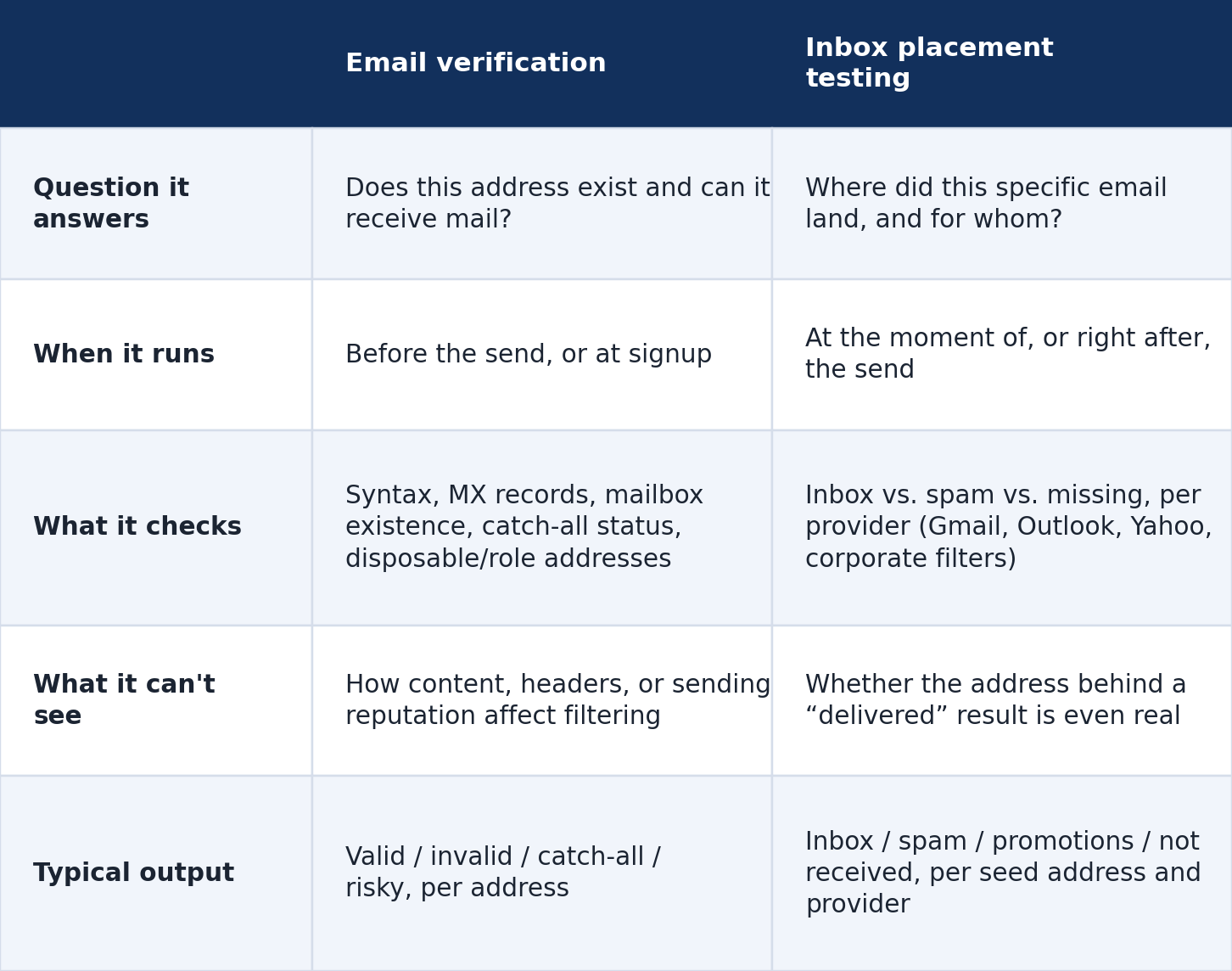
Neither one replaces the other, because a “valid” address can still land in spam, and a “delivered to inbox” result on a seed list tells you nothing about the 40% of your real list that’s disposable or dead.
What email verification actually catches
Verification is a pre-send filter on your list itself. It checks:
- Syntax and domain validity — malformed addresses and non-existent domains
- Mailbox existence — via SMTP-level checks, so far as a receiving server allows
- Catch-all detection — domains that accept mail for any address, which hide dead mailboxes behind a “delivered” response
- Risk signals — disposable domains, role addresses (info@, support@), and known spam traps
This is what keeps your hard bounce rate low and protects the sender reputation that everything else depends on. Bulk verification and catch-all resolution both operate here, before a single campaign email goes out.
What verification cannot tell you: whether Gmail’s spam filter likes your subject line, whether your IP is on a blocklist, or whether Outlook is throttling your domain. A list can be 100% verified valid and still get filtered into spam, because filtering happens on factors verification doesn’t measure — content, authentication, reputation and engagement history.
What inbox placement testing actually catches
IPT sends a real (or representative) email to a seed list — a set of test addresses spread across major providers and corporate filters (Mimecast, Proofpoint, Barracuda) that the testing tool monitors. It then reports where each copy landed: inbox, spam, promotions tab, or nowhere at all.
This surfaces:
- Provider-specific filtering — a campaign that sails into Gmail can still get filtered at Outlook or a corporate gateway
- Authentication problems — misconfigured SPF, DKIM or DMARC often show up here first
- Content and reputation triggers — subject lines, links or sending patterns that spam filters flag
- IP and domain reputation drops — visible as a sudden fall in inbox rate across providers
What IPT cannot tell you: whether your actual subscriber list is full of dead or fake addresses. A seed list is small (typically 100–500 addresses) and curated by the testing vendor. It says nothing about the health of the tens of thousands of real contacts you’re about to email.
Where each one fails on its own
Verification alone: You send to a perfectly clean, 100%-verified list, but your domain has no DMARC record, or last week’s campaign got flagged for spam complaints. The list is fine. The message still goes to spam. Verification has no visibility into filtering behavior.
IPT alone: Your seed test shows a 95% inbox placement rate. You feel confident and blast the same campaign to your full list, which hasn’t been cleaned in a year. A quarter of it is dead, role-based or disposable. Your real bounce rate spikes, your real spam complaint rate climbs, and your reputation degrades. The seed list can’t reflect that, because it’s a small, controlled panel, not your actual subscriber base.
This is the core reason to run both: verification protects the input, IPT measures the output. Skipping either one leaves half the picture missing.
How the two fit together in a sending workflow
Step 1: Verify before every send. Clean the list with bulk verification, or check addresses in real time at capture through the verification API. This is the baseline every send should start from.
Step 2: Authenticate your domain. Confirm SPF, DKIM and DMARC are correctly configured. IPT results are hard to interpret if authentication is broken, since that alone can tank placement regardless of list quality.
Step 3: Run an inbox placement test before a major send. Send to a seed list ahead of a large campaign, a new domain warm-up, or after any change to content, sending infrastructure or IP. Read the placement rate per provider, not just an overall average.
Step 4: Monitor sender reputation continuously. Use email scoring and a deliverability check alongside Google Postmaster Tools, so a reputation drop shows up before it becomes a placement problem.
Step 5: Re-verify on a schedule, not just once. Lists decay as people change jobs and domains die. Re-verify quarterly at minimum, and before any send to a list that’s been dormant for more than a few months. Connect this to your workflow through integrations like HubSpot, Clay or Zapier so it doesn’t rely on someone remembering to do it.
Step 6: Treat a placement drop as a diagnostic signal, not a one-off. If IPT shows placement falling at one provider, don’t assume it’s a one-time glitch. Check authentication first, then recent content changes, then list hygiene, in that order. Change one variable at a time and retest, rather than reacting to a single result.
A quick way to tell which tool you need
- “Are my bounce rates high?” → List quality problems. Start with verification.
- “My list is clean but open rates are low” → Filtering problem. Run an inbox placement test.
- “I’m about to warm up a new domain or IP” → You need both: a verified list to send to, and IPT to watch placement climb as you scale volume.
- “Placement was fine last month and dropped suddenly” → Check authentication and reputation first (IPT will show you where), then check whether your last list import skipped verification.
What neither tool fixes
- Consent. Verification confirms an address is real; it doesn’t confirm the person opted in. Follow GDPR, CAN-SPAM and similar rules regardless of list quality.
- Content and offer quality. A clean list with strong placement still won’t convert if the message itself is weak.
- Engagement decay. Even valid, well-placed emails lose impact if you email disengaged contacts too often. Sunset or re-permission inactive segments separately.
- 100% accuracy. No verifier or seed-list tool is perfect. Mail server behavior changes, and some corporate gateways block automated checks entirely. Treat both as strong risk reduction, not a guarantee.
FAQ
Do I need inbox placement testing if I already verify my list?
Yes, if you send at meaningful volume or to cold contacts. Verification protects your list quality; IPT is the only way to see how filters, authentication and reputation are actually treating your mail.
How often should I run an inbox placement test?
Before major campaigns, after any change to sending infrastructure, content templates or domain, and periodically (monthly is common for high-volume senders) to catch reputation drift early.
Can a verified list still end up in spam?
Yes. Verification confirms the address is real and reachable; it says nothing about your authentication setup, sending reputation or content. Both must be right for the message to reach the inbox.
Which should I set up first if I’m starting from nothing?
Verification. A clean list is the foundation everything else depends on, and it’s the faster, cheaper win. Add inbox placement testing once you’re sending at volume and need visibility into provider-level filtering.
Conclusion
Email verification and inbox placement testing aren’t competing tools; they check two different points of failure. Verification keeps bad addresses from ever reaching your send. IPT tells you what happened to the good ones once they left. Running only one leaves a blind spot that eventually shows up as a bounce spike, a spam-folder drop, or both.
Start with the list. Verify a sample with 100 free credits and see how much of it is actually reachable before you worry about where it lands.
Start cleaning your list instantly.
No credit card required.