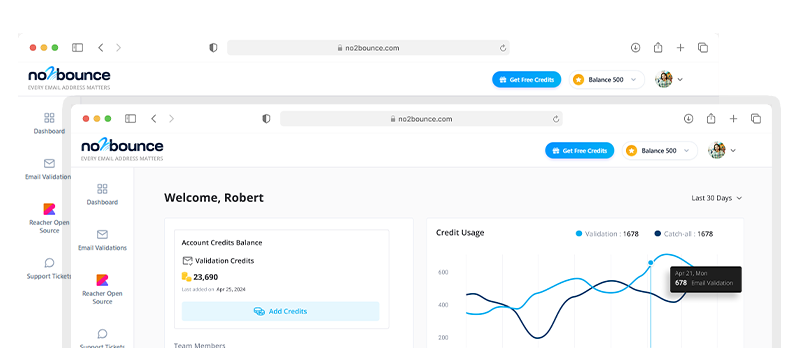

Sending emails to invalid addresses can silently damage your sender reputation, increase bounce rates, and reduce inbox placement.
The good news is that you can verify an email address without sending a single email.
Modern email verification combines syntax validation, DNS checks, MX record lookups, SMTP verification, catch-all detection, and AI-powered risk analysis to determine whether an email address is safe to send to.
In this guide, we’ll explain five proven methods to verify email addresses without sending emails and how businesses can automate through trusted email validation using platforms like no2bounce.
Why Email Verification Matters Before Sending
Every email list naturally decays over time.
Employees leave companies, domains expire, inboxes become inactive, and fake emails enter databases through forms and imports.
Sending emails to invalid contacts can lead to:
- Higher bounce rates
- Spam complaints
- Poor sender reputation
- Lower inbox placement
- Reduced campaign ROI
Modern mailbox providers like Gmail and Outlook heavily monitor bounce behavior and sender quality signals.
What Is Email Verification?
Email verification is the process of determining whether an email address:
- Exists
- Can receive emails
- Is safe to send to
- Belongs to a risky or catch-all domain
Modern email validation services typically use multiple verification layers:
- Syntax validation
- Domain verification
- MX record checks
- SMTP verification
- Catch-all detection
- Disposable email detection
- AI-based risk scoring
5 Methods for Verifying Email Address
Here are the 5 methods for verifying an email address without sending an email
Method 1: Syntax Validation
Syntax validation checks whether the email follows the correct format.
Example:
john@example.com ✅
john@@example ❌
john.example.com ❌
This process identifies:
- Missing “@” symbols
- Invalid characters
- Incorrect domains
- Formatting issues
Syntax validation is the first layer of email verification but does not confirm whether the mailbox actually exists.
Method 2: Domain & MX Record Verification
The next step is checking whether the domain can receive emails.
Verification systems analyse:
- DNS records
- MX records
- Domain configuration
If a domain has no MX records, it cannot receive emails.
Example command:
nslookup -type=MX company.com
This helps identify:
- Expired domains
- Misconfigured mail servers
- Nonexistent domains
Method 3: SMTP Email Verification
SMTP verification is one of the most accurate email validation methods available.
Instead of sending an email, the verifier:
- Connects to the mail server
- Initiates an SMTP handshake
- Checks mailbox availability
- Disconnects before sending a message
Example SMTP responses:
250 OK → mailbox likely exists
550 User Unknown → invalid mailbox
SMTP verification is highly effective but modern mail servers sometimes restrict verification attempts for security and privacy reasons.
Method 4: Catch-All Email Validation
Catch-all domains accept all incoming emails, even for mailboxes that may not exist.
This creates hidden deliverability risks because:
- SMTP checks may appear valid
- Emails can bounce later
- Engagement signals become unreliable
Experts increasingly recommend multi-layer catch-all analysis instead of relying only on SMTP checks.
Modern verification platforms use:
- Historical bounce data
- Behavioral signals
- Domain intelligence
- AI scoring systems
to classify catch-all emails more accurately.
Method 5: Use an AI-Powered Email Verification Tool
Manual verification methods become difficult at scale.
AI-powered email verification tools combine:
- Syntax validation
- DNS checks
- MX verification
- SMTP testing
- Catch-all analysis
- Risk scoring
- Deliverability intelligence
into a single automated workflow.
Platforms like no2bounce help businesses:
- Verify email addresses in bulk
- Detect risky emails
- Reduce bounce rates
- Protect sender reputation
- Improve deliverability
How AI Improves Email Verification Accuracy
Traditional email verification often struggles with:
- Catch-all domains
- Greylisting
- Delayed bounces
- Temporary SMTP failures
AI improves accuracy by analysing:
- Historical verification behavior
- Bounce timing
- Domain reputation
- Engagement signals
- Predictive risk patterns
Modern AI systems can classify emails as:
- Valid
- Invalid
- Risky
- Catch-all
- Disposable
- Unknown
Bulk Email Verification vs Single Email Checks
Single Email Verification
Best for:
- Signup forms
- CRM lead entry
- Contact validation
Bulk Email Verification
Best for:
- CRM cleanup
- Marketing databases
- Cold outreach
- Legacy contact imports
Bulk email verification tools help businesses process thousands or millions of email addresses efficiently.
How to Automate Email Verification in Zoho CRM
Businesses increasingly use zoho crm email verification workflows to prevent invalid contacts from entering their CRM.
Automated workflows can:
- Verify leads during form submissions
- Suppress invalid emails
- Detect catch-all domains
- Clean email lists in Zoho CRM
- Improve campaign deliverability
AI-powered verification also improves lead scoring accuracy by identifying risky or low-quality contacts.
Salesforce Email Verification Explained
Salesforce users commonly implement:
- salesforce email validation
- salesforce email address validation
- email field validation in salesforce
to maintain clean CRM data.
Email verification inside Salesforce helps:
- Reduce bounce rates
- Improve sales outreach
- Prevent fake signups
- Protect sender reputation
HubSpot Email Validation Best Practices
HubSpot email verification workflows are important because invalid emails can break automation sequences and distort analytics.
Businesses often automate:
- hubspot email validation
- hubspot form email validation
- hubspot email checker workflows
to improve CRM hygiene and marketing performance.
Automate Email Verification with Zapier
Zapier makes it possible to automate email verification across apps without coding.
Example workflow:
Lead Form
→ Email Verification API
→ CRM Update
→ Slack Notification
This helps businesses automate email validation across marketing and sales systems.
Clay Email Verification Workflows
Clay email verification is increasingly important for outbound prospecting and lead enrichment workflows.
Businesses commonly verify emails before:
- Cold outreach
- Lead enrichment
- CRM imports
- Campaign launches
to reduce bounce risks.
How Email Reputation Impacts Deliverability
Mailbox providers evaluate:
- Bounce rates
- Complaint rates
- Engagement
- Domain reputation
- Sending consistency
Poor-quality email lists can damage sender reputation and reduce inbox placement over time.
This is why businesses increasingly use:
- email reputation checker tools
- domain reputation monitoring
- AI-based deliverability analysis
before sending campaigns.
Best Practices for Email Validation
- Verify Emails at the Point of Entry: Prevent invalid emails from entering your CRM.
- Clean Lists Regularly: Email databases decay continuously.
- Segment Catch-All Emails: Treat risky emails separately.
- Monitor Bounce Rates: High bounce rates damage deliverability.
- Use AI-Based Verification: AI improves catch-all detection and risk analysis.
Frequently Asked Questions
Can you verify an email address without sending an email?
Yes. Modern email verification tools use syntax checks, DNS lookups, MX validation, SMTP verification, and AI-based analysis to verify emails without sending messages.
What is SMTP email verification?
SMTP verification checks whether a mailbox exists by communicating directly with the mail server without sending an actual email.
What is catch-all email validation?
Catch-all email validation identifies domains configured to accept all incoming emails, helping businesses reduce the risk of hidden bounces.
Why is AI important in email verification?
AI improves email verification accuracy by analysing bounce behavior, domain reputation, engagement signals, and risk patterns.
Conclusion
Verifying email addresses before sending campaigns is essential for protecting sender reputation, reducing bounce rates, and improving deliverability.
While manual methods like syntax validation, MX lookups, and SMTP verification can help validate addresses individually, businesses increasingly rely on AI-powered email verification platforms for better accuracy and scalability.
no2bounce combines SMTP verification, catch-all detection, bulk email verification, and AI-powered email scoring to help businesses maintain cleaner email databases and improve campaign performance.
Start cleaning your list instantly.
No credit card required.