To marketing and sales teams, it can be the difference between working with reliable contact data and wasting resources on addresses that cannot receive messages.
The best way to make the business case for email verification is to connect it to measurable business outcomes: reduced data waste, less manual cleanup, fewer avoidable delivery failures, and more reliable campaign reporting.
Instead of asking your boss to approve another marketing tool, show them the problem with your current email data, estimate the cost of that problem, and explain how verification could help address it.
This guide walks you through building a practical business case, calculating potential ROI, measuring results, and presenting a proposal your finance team can evaluate.
Why Email Verification Is a Business Investment, Not Just a Marketing Tool
Every email campaign depends on the quality of its recipient data. When a list contains invalid, outdated, or incorrectly formatted addresses, some messages will fail before they reach their intended recipients.
The consequences can extend beyond a single campaign. Poor contact data can create unnecessary sending costs, distort campaign metrics, consume employee time, and contribute to deliverability problems.
Mailchimp explains that high bounce rates can affect sending reputation and may trigger warnings or account restrictions. Google also recommends monitoring delivery errors, spam rates, authentication, and domain reputation as part of responsible email sending practices.
Sources: Mailchimp's guide to bounce warnings and Google's email sender guidelines.
Email verification helps identify addresses that may be invalid or risky before you send a campaign. It does not guarantee inbox placement or eliminate every bounce, but it provides an additional layer of control over contact data quality.
For a business, that creates four areas worth evaluating:
- Cost efficiency: Avoid unnecessary sending and contact-management expenses where applicable.
- Operational productivity: Reduce repetitive manual checks and list-cleaning work.
- Deliverability risk management: Help identify problematic addresses before they enter a campaign.
- Marketing performance: Improve the reliability of campaign delivery metrics and lead-generation workflows.
The objective is not to claim that verification will automatically increase revenue. It is to establish whether the expected benefits justify the investment for your organization.
1. Start With the Business Problem, Not the Software
Before discussing pricing, identify where email quality is creating a measurable problem.
Your finance team is more likely to engage with a business case that starts with existing costs and operational risks than one that begins with a list of product features.
Identify the problems in your current email workflow
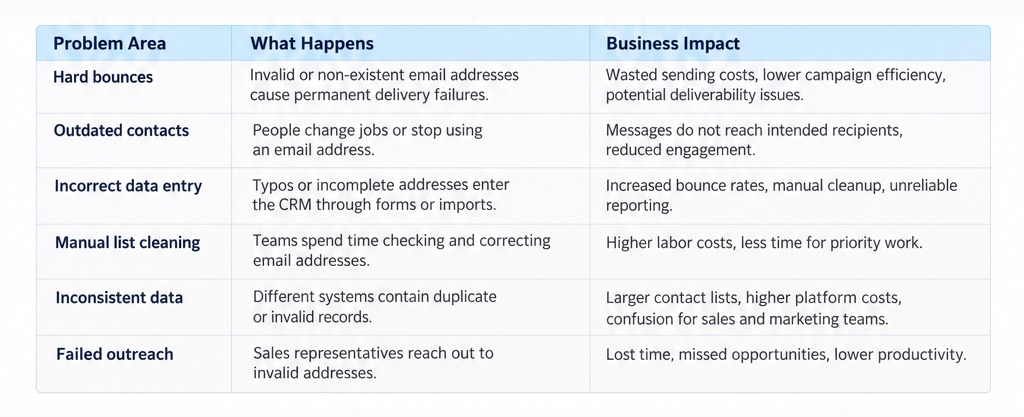
Review your recent campaigns, CRM records, and lead-generation processes. Look for evidence such as:
- Hard bounces from invalid or non-existent email addresses.
- Outdated contacts that have not been checked recently.
- Incorrect addresses entering the CRM through forms, imports, or integrations.
- Sales representatives spending time investigating undeliverable leads.
- Repeated manual cleanup before marketing campaigns.
- Inconsistent contact data across marketing and sales systems.
Separate confirmed problems from suspected ones. For example, a campaign report can establish the number of recorded hard bounces, while the cost of lost opportunities may require additional analysis.
Establish your baseline metrics
Collect data from a representative period before proposing a solution.
Useful baseline metrics include:
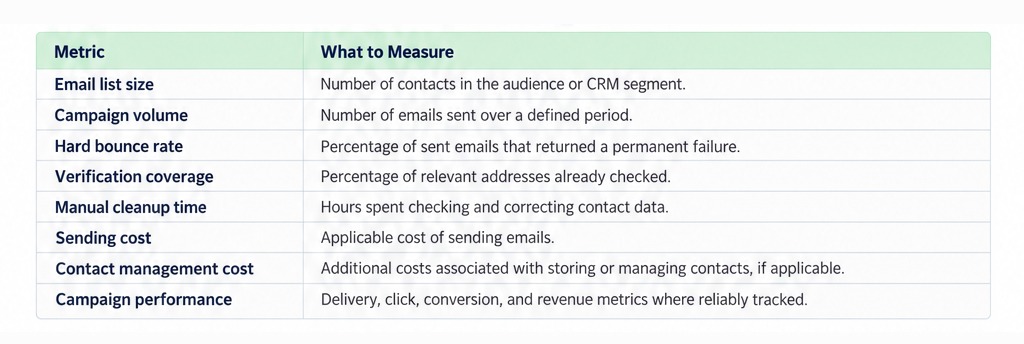
Use actual figures from your email service provider, CRM, finance records, and campaign reports wherever possible.
This gives you a defensible starting point for the proposal.
2. Calculate What Poor Email Data Is Costing Your Business
The next step is to translate the problem into financial terms.
There is no universal cost for a bad email address. The impact depends on your email platform's pricing model, how frequently you send campaigns, how much manual work is required, and whether failed delivery affects your business outcomes.
A useful model separates direct costs from potential benefits.
A. Direct email sending costs
If your provider charges based on email volume, you may be paying to send messages to addresses that cannot receive them.
Use this formula:
Annual avoidable sending cost = Avoidable invalid sends × Cost per email
For recurring campaigns, calculate the total across the year. If your provider charges by stored contact count rather than sends, use the applicable contact-pricing model instead.
Do not assume that every invalid address generates a separate charge. Some providers remove hard-bounced contacts automatically, while others have different billing rules.
B. Employee time spent on manual cleanup
Manual verification and list cleaning can consume time that sales and marketing teams could spend on higher-value work.
Calculate the cost using:
Annual manual cleanup cost = Hours spent per month × Loaded hourly employee cost × 12
The loaded hourly cost should reflect the relevant salary and employment overheads according to your organization's accounting practices.
For example, if a marketing operations employee spends three hours each month manually checking and cleaning contact lists, and the estimated loaded hourly cost is $35:
3 hours × $35 × 12 months = $1,260 per year
This represents the annual labor value associated with that workload. It becomes a genuine saving only if verification reduces the work and the released capacity creates measurable value.
C. CRM and contact management costs
Some platforms charge according to the number of contacts stored. If invalid or redundant records count toward a billing threshold, cleaning them may reduce costs.
Calculate the potential saving using your provider's actual pricing tiers and billing rules.
Do not count this benefit if your platform does not charge for those records or if removing them does not change your bill.
D. Potential campaign and revenue impact
Poor data quality may contribute to failed deliveries and unreliable campaign performance. However, it is difficult to assign a precise revenue value to email verification without controlled measurements.
Instead of assigning a speculative value to every invalid address, establish a baseline and test the change after verification.
Treat improvements as observed benefits only after comparing results and accounting for other factors, such as campaign content, audience engagement, sending frequency, and seasonality.
3. Build a Simple Email Verification ROI Model
Once you understand the existing costs, compare them with the total cost of verification.
A basic ROI formula is:
ROI (%) = (Measured benefits − Total costs) ÷ Total costs × 100
For this calculation, measured benefits can include verified reductions in sending costs, actual labor savings, and confirmed reductions in contact-management expenses.
Potential revenue gains and deliverability improvements should be reported separately until your data supports a reasonable estimate.
Example: A hypothetical business case
Consider a company that maintains a large contact database and spends time cleaning lists manually.
The following figures are illustrative assumptions, not industry benchmarks or guaranteed no2bounce results.
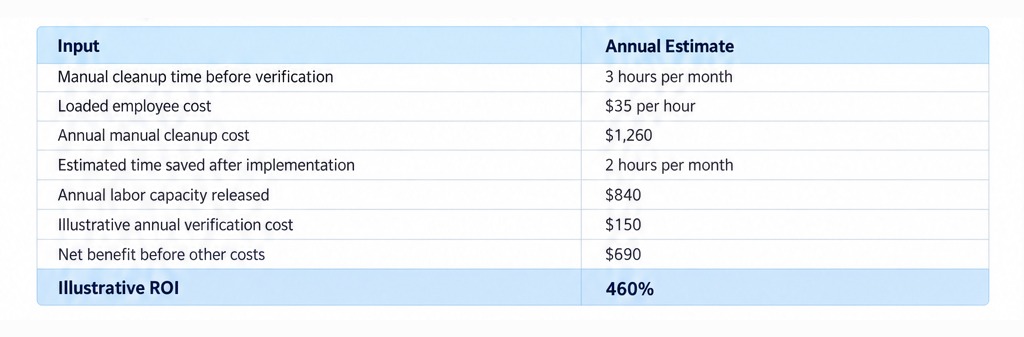
The estimated labor value released is:
2 hours × $35 × 12 months = $840.
The illustrative ROI is:
($840 − $150) ÷ $150 × 100 = 460%
This calculation assumes the two hours saved every month are genuinely attributable to verification and that the $150 covers the relevant annual verification expense. It excludes implementation costs, training, and any additional operational expenses.
The example demonstrates the method, not the expected return for every business.
If the time savings cannot be verified, the finance team should not treat the entire $840 as realized cash savings. It may instead represent capacity that can be redirected toward other work.
Account for the full cost of implementation
Your cost estimate should include more than the software subscription or verification credits.
Consider:
- Verification credits or subscription charges.
- Initial setup and integration work.
- Employee time required for implementation.
- Ongoing monitoring and maintenance.
- Any additional processing or data-management costs.
Then compare the full cost against conservative, measurable benefits.
A transparent model is more persuasive than a large ROI percentage built on assumptions.
4. Explain the Risks of Not Verifying Email Addresses
Finance teams often evaluate both the expected return from a purchase and the cost of leaving an existing problem unresolved.
Email verification can support risk management by identifying certain problematic addresses before they are used in campaigns.
Avoidable bounces and sending restrictions
High hard-bounce rates can indicate that a list contains invalid addresses or that contact acquisition and maintenance practices need attention.
Email service providers may issue warnings or restrict sending when bounce rates become excessive. The specific thresholds and enforcement rules depend on the provider.
Verification can help identify some invalid addresses before sending, but it cannot eliminate bounces caused by temporary server failures, changing mailbox conditions, or other delivery issues.
Sender reputation and deliverability
A clean email list is one part of responsible email sending, not a complete deliverability strategy.
Google's sender guidance also covers authentication, spam complaint rates, sending practices, and other requirements. Email verification should therefore complement domain authentication, consent management, audience segmentation, and ongoing monitoring.
Reference: Google's email sender guidelines.
Lost sales and wasted outreach
For B2B organizations, incorrect addresses can interrupt prospecting and follow-up workflows.
A sales representative may spend time researching a prospect, preparing personalized outreach, and scheduling follow-ups, only to discover that the address is invalid.
To estimate the operational impact, measure how many outreach records fail because of invalid email addresses and the average time spent handling them. Avoid assuming that every invalid address represents a lost sale.
The business case becomes stronger when it shows how much of this work is preventable and how the team can measure the change.
5. Show How Email Verification Fits Into Your Existing Workflow
Your manager may ask whether email verification will create another complicated process.
The proposal should explain where verification fits into existing systems and how it can minimize unnecessary manual work.
For marketing teams
Verify relevant contact lists before sending campaigns, webinars, newsletters, or product announcements.
A repeatable workflow can help identify invalid and risky addresses before they enter a campaign, while preserving the distinction between verification status and marketing consent.
For sales teams
Check prospect email addresses before adding them to outreach sequences. This can help reduce avoidable failures and improve the quality of the contact data entering sales workflows.
Verification does not establish that a prospect is interested in your product or has consented to receive marketing communications.
For operations and CRM teams
Integrate verification into relevant contact-import or data-cleaning workflows so that new records can be assessed before they are used.
Where supported, API-based or CRM-integrated verification can reduce repetitive manual steps. The business case should include the actual integration requirements and maintenance effort.
For finance teams
Create a recurring report that compares verification costs with observed outcomes.
Include the number of addresses checked, the number of invalid addresses identified, actual time saved, changes in sending costs, and relevant delivery metrics.
This makes it easier to determine whether the investment continues to justify its cost.
6. Propose a Pilot Before Requesting a Larger Budget
A pilot reduces the risk of committing to a tool before understanding its practical value.
Rather than requesting a large annual budget immediately, propose a controlled test using a representative list or workflow.
Step 1: Select a relevant sample
Choose a list that reflects your real business use case. It might be a recent lead import, an upcoming campaign audience, or a CRM segment that requires cleanup.
Document where the contacts came from and how old the records are.
Step 2: Record the starting metrics
Before verification, document the list size, existing bounce rates, manual processing time, applicable costs, and other relevant performance metrics.
Use a comparable historical period where possible.
Step 3: Verify the selected contacts
Use an email verification tool to assess the addresses and classify the results according to the tool's supported statuses.
Review uncertain or catch-all results separately. Do not assume that an address marked unknown is invalid, or that a valid result guarantees inbox placement.
Step 4: Apply a documented decision policy
Define how your organization will handle invalid, risky, disposable, catch-all, and unknown addresses.
The policy should reflect your risk tolerance, the origin of the contacts, applicable consent requirements, and the intended sending activity.
Step 5: Measure the results
Compare the pilot with your baseline using appropriate metrics. Where possible, use similar audiences and comparable sending conditions to reduce confounding factors.
Measure actual cost differences and operational changes rather than attributing every improvement to verification.
Step 6: Present the findings
Summarize the verification cost, number of addresses checked, findings, time required, observed outcomes, limitations, and recommended next steps.
If the results are inconclusive, recommend a larger or better-controlled test instead of claiming a proven ROI.
7. How to Present the Proposal to Your Boss or Finance Team
A strong business case should be concise enough for a decision-maker to review quickly.
Structure your proposal around five questions.
1. What problem are we solving?
Explain the current issues with email data and provide supporting evidence from campaign reports, CRM records, or operational workflows.
2. What is the current cost?
Show the estimated sending expenses, manual cleanup time, contact-management costs, and any other directly measurable costs.
3. What are we proposing?
Describe the verification process, the tool under consideration, the relevant integration requirements, and the implementation plan.
4. What return do we expect?
Provide a conservative ROI estimate based on documented assumptions. Separate confirmed savings from potential benefits that still need to be tested.
5. How will we measure success?
Define the pilot duration, baseline metrics, reporting process, success criteria, and conditions for expanding or stopping the project.
This format makes the decision easier because it focuses on evidence, cost control, and measurable outcomes.
8. A Copy-Ready Email to Request Approval
Use the following template to present your business case internally.
Subject: Proposal to Evaluate Email Verification for Better Data Quality
Hi [Manager's Name],
I would like to propose a small email verification pilot to evaluate whether improving our contact data quality can reduce avoidable delivery failures and manual list-cleaning work.
Our current process involves [briefly describe the existing issue], which affects [relevant campaign, CRM, or sales workflow].
I propose verifying a representative sample of [number] email addresses using an email verification tool and comparing the results with our current process.
We will evaluate:
- The number and percentage of invalid or risky addresses identified.
- The time required for manual cleanup before and after the pilot.
- Any measurable changes in sending or contact-management costs.
- Relevant campaign delivery and performance metrics.
- The total verification and implementation cost.
We will document the assumptions, results, and limitations before recommending any wider implementation. This will help us determine whether the investment provides sufficient operational or financial value.
If the pilot demonstrates measurable benefits against the agreed criteria, we can prepare a larger implementation proposal.
Please let me know if I can proceed with the pilot and prepare the cost estimate.
Best regards,
[Your Name]
9. Common Mistakes to Avoid When Building the Business Case
Even a useful tool can be difficult to approve if its benefits are presented without sufficient evidence.
Avoid these common mistakes:
- Promising guaranteed inbox placement. Verification helps assess addresses but cannot guarantee that messages reach the inbox.
- Using industry averages without context. Your own list quality, sending practices, and provider pricing are more relevant to your business case.
- Counting speculative revenue as guaranteed savings. Revenue impact should be supported by measured results and a defensible attribution method.
- Ignoring implementation costs. Include setup, integration, maintenance, and employee time.
- Treating all uncertain addresses as invalid. Some addresses cannot be conclusively classified, and the appropriate handling policy depends on your risk tolerance.
- Failing to define success criteria. Decide what evidence would justify expansion before starting the pilot.
- Ignoring consent and data governance. Verification does not make an unconsented contact eligible for marketing. Continue to follow applicable privacy laws and sending-provider requirements.
The goal is to demonstrate a credible business benefit, not to make every possible benefit appear certain.
10. How no2bounce Can Support Your Email Verification Business Case
If your business needs a repeatable way to assess email list quality, no2bounce provides email verification capabilities that can be evaluated as part of your proposed workflow.
Depending on your requirements, you can assess its bulk email validation, catch-all verification, email verification API, and relevant integrations to determine how they fit your existing process.
For the business case, focus on the capabilities that address your specific problem rather than buying features you do not need.
Start by identifying the volume of addresses you want to check, how frequently you need verification, which systems are involved, and how you will measure the results.
You can then use a small, representative test to evaluate the workflow before making a broader purchasing decision.
Ready to evaluate your email data quality?
Explore no2bounce and assess whether its email verification capabilities fit your requirements. Use your own contact data, workflow, and cost assumptions to build an evidence-based case for approval.
Frequently Asked Questions
Is email verification worth the cost for a small business?
It can be, particularly when a business regularly sends campaigns, maintains a large contact database, or spends considerable time correcting email data. The decision depends on verification costs, list quality, sending frequency, and the value of the work saved. A small pilot can help establish whether the investment is justified.
How do you calculate the ROI of email verification?
Subtract the total verification and implementation costs from the measurable benefits, divide the result by those costs, and multiply by 100. Include verified savings from sending, contact management, or labor where applicable. Keep speculative revenue gains separate until they are supported by evidence.
Can email verification improve deliverability?
Verification can help identify invalid addresses before sending, potentially reducing avoidable hard bounces. However, inbox placement also depends on sender reputation, authentication, recipient engagement, message content, sending practices, and other factors. Verification alone does not guarantee better deliverability.
How often should a business verify its email list?
The appropriate frequency depends on how quickly the data changes and how it enters your systems. Consider verifying new addresses at collection or import, reviewing older lists before significant campaigns, and establishing recurring checks based on your data quality and sending practices.
What metrics should finance teams use to evaluate email verification?
Useful measures include total verification cost, invalid addresses identified, actual sending-cost changes, manual hours saved, contact-management savings, hard bounce rates, and relevant campaign outcomes. Define a baseline and compare results under reasonably consistent conditions.
Should we verify every email address in our CRM?
Not necessarily. Prioritize addresses that will be used in relevant outreach or marketing workflows. Consider data freshness, verification history, intended use, provider pricing, and your organization's risk policy before deciding which records to verify.
What is the difference between email verification and email deliverability?
Email verification assesses whether an address appears capable of receiving email based on available technical signals. Email deliverability concerns whether messages are successfully delivered and, more specifically, reach the intended inbox rather than being rejected or filtered into spam. Verification supports list hygiene but does not replace a broader deliverability strategy.
Final Thoughts
Making the business case for email verification is about showing how better contact data can support more efficient operations and more reliable email campaigns.
Start with your current costs, build a transparent ROI model, account for implementation expenses, and distinguish measured savings from potential benefits. Then test the proposed workflow on a representative sample and report the results honestly.
When your proposal is supported by evidence and clear success criteria, email verification becomes a business decision that your manager and finance team can evaluate rather than simply another software request.
Start cleaning your list instantly.
No credit card required.