
Email marketing performance depends heavily on one thing many businesses overlook: email data quality.
Invalid email addresses, catch-all domains, disposable inboxes, and spam traps can increase bounce rates, hurt deliverability, and damage sender reputation.
That is why businesses use email validation tools to verify email addresses before sending campaigns.
Modern email validators now go beyond basic syntax checks. Many platforms use AI-powered email verification, predictive risk analysis, and machine learning to identify risky emails before they impact campaign performance.
In this guide, we tested and ranked the best free email validators in 2026 based on accuracy, deliverability protection, catch-all detection, API access, bulk verification capabilities, and AI-powered verification features.
Whether you are a marketer, SDR, SaaS company, ecommerce brand, or agency, this guide will help you choose the right email validation tool for your workflow.
TL;DR
- Free email validation tools still play an important role in 2026. Most platforms offer limited free credits or free email checker features that help businesses identify invalid, disposable, catch-all, and risky email addresses before sending campaigns.
- Free email verification tools are ideal for testing, small email lists, and occasional database cleaning. However, growing businesses often require paid plans for bulk email verification, API automation, real-time validation, AI-powered risk analysis, and advanced deliverability protection.
- Modern AI-powered email validators now go beyond basic syntax checks. Many platforms use machine learning and predictive email risk scoring to improve verification accuracy and protect sender reputation.
- no2bounce is a strong option for businesses looking to improve deliverability through bulk email verification, catch-all detection, AI-driven email validation, and real-time email verification workflows.
What Is an Email Validator?
An email validator is a tool that checks whether an email address is real, active, and safe to send emails to.
Modern email validation software analyzes multiple technical signals, including:
- Email syntax
- Domain validity
- MX records
- SMTP server responses
- Disposable email providers
- Spam trap indicators
- Catch-all configurations
- Role-based inboxes
- AI-based risk scoring
The goal is not just to identify valid email addresses, but also to detect risky emails that could negatively impact sender reputation and inbox placement.
Why Email Validation Matters in 2026
Email ecosystems have evolved significantly in recent years.
Mailbox providers like Gmail and Outlook now rely heavily on AI-based spam filtering systems to evaluate sender quality and email trustworthiness.
Even moderate bounce rates can reduce inbox placement and affect future campaign performance.
Poor email hygiene often leads to:
- Higher hard bounce rates
- Lower sender reputation
- Spam folder placement
- Domain blacklisting
- Reduced email engagement
- Wasted campaign spend
A clean email database helps improve:
- Inbox placement
- Open rates
- Click-through rates
- Deliverability
- Campaign ROI
- Overall email performance
For businesses running outbound campaigns at scale, email validation has become an essential part of email deliverability optimization.
18 Best Free Email Validators in 2026
1. no2bounce
Best for: AI-powered catch-all email verification and deliverability protection platform
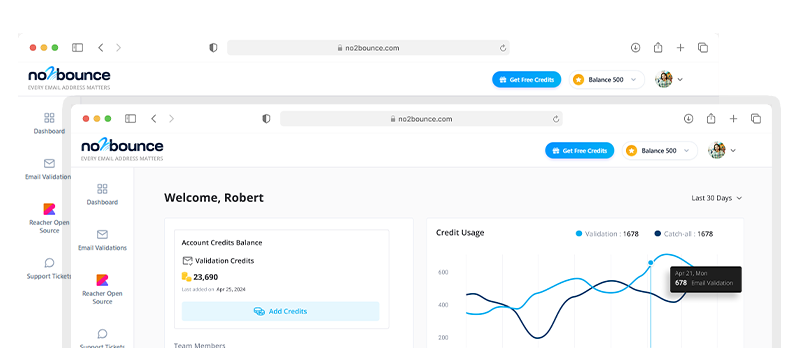
no2bounce focuses on accurate email verification with advanced deliverability protection features designed to reduce bounce rates and maintain sender reputation.
Key features:
- Bulk email verification
- AI-powered email validation
- Catch-all email detection
- Real-time email verification API
- SMTP validation
- Role-based email detection
- Email Scoring
- Email Cleaning
Why it stands out: no2bounce combines email verification with AI-driven deliverability optimization, helping businesses identify risky email addresses before campaigns are sent.
Free plan: Limited free verification credits available.
2. ZeroBounce
Best for: Enterprise email verification
ZeroBounce offers advanced email validation features including spam trap detection and AI-based email scoring.
Key features:
- AI-powered email scoring
- Abuse email detection
- Catch-all analysis
- Email activity data
- Deliverability monitoring
3. NeverBounce
Best for: Large-scale email list cleaning
NeverBounce is widely used for bulk email list cleaning and CRM synchronization.
Key features:
- Real-time verification
- Bulk validation
- Automated list syncing
- Email hygiene workflows
4. Hunter
Best for: Lead generation teams
Hunter combines email finding and email verification for prospecting workflows.
Key features:
- Email finder
- Domain search
- Email verification
- Chrome extension
5. Bouncer
Best for: User-friendly email validation
Bouncer offers reliable bulk verification with a clean and simple interface.
Key features:
- Bulk email validation
- Toxic email detection
- API access
- Deliverability monitoring
6. Kickbox
Best for: API integrations
Kickbox provides developer-focused email validation infrastructure.
Key features:
- SMTP verification
- Disposable email detection
- Real-time verification API
- Deliverability optimization
7. Emailable
Best for: SMBs and startups
Emailable offers affordable email verification with fast processing.
Key features:
- Bulk email validation
- Email scoring
- API integrations
- Team collaboration
8. Clearout
Best for: Prospecting workflows
Clearout focuses heavily on outbound sales and lead generation.
Key features:
- LinkedIn email extraction
- Verification API
- Catch-all detection
- CRM integrations
9. Verifalia
Best for: Technical validation depth
Verifalia provides advanced email validation layers and configurable quality scoring.
Key features:
- Syntax verification
- Mailbox validation
- DNS checks
- Quality scoring
10. MillionVerifier
Best for: Affordable bulk verification
MillionVerifier is commonly used by agencies and cold email marketers.
Key features:
- Bulk email verification
- Deliverability optimization
- Catch-all detection
- Duplicate removal
11. Snov.io
Best for: Sales engagement workflows
Snov.io combines email verification with outbound automation.
Key features:
- Email finder
- Verification workflows
- Drip campaigns
- CRM integrations
12. MailerCheck
Best for: Email marketers
MailerCheck focuses on improving email campaign deliverability.
Key features:
- Spam trap detection
- Domain validation
- Email cleaning
- Bounce prevention
13. DeBounce
Best for: Budget-conscious teams
DeBounce offers affordable email validation for smaller businesses.
Key features:
- Duplicate removal
- SMTP checks
- Catch-all verification
- Temporary email detection
14. QuickEmailVerification
Best for: Fast verification speed
QuickEmailVerification is optimized for speed and API-based workflows.
Key features:
- Real-time verification
- Bulk processing
- MX record validation
- Integrations
15. Mailgun Validate
Best for: Developers and SaaS products
Mailgun offers email verification APIs designed for transactional email systems.
Key features:
- Syntax validation
- Mailbox verification
- Real-time API infrastructure
- Email quality checks
16. EmailListVerify
Best for: Simple email list cleaning
EmailListVerify provides straightforward bulk verification tools.
Key features:
- Spam trap detection
- Disposable email filtering
- Domain validation
- Syntax checks
17. Prospeo
Best for: Sales prospecting
Prospeo combines lead generation with email verification workflows.
Key features:
- Email finder
- Email verification
- CRM enrichment
- Prospecting automation
18. Skrapp
Best for: LinkedIn lead generation
Skrapp helps sales teams verify prospect emails collected through LinkedIn.
Key features:
- LinkedIn integration
- Email verification
- Bulk exports
- Prospecting tools
Comparison Table: Best Free Email Validators
How to Check If an Email Address Is Valid (Free Methods)
Checking whether an email address is valid involves much more than confirming that it contains an “@” symbol.
Modern email validation tools use multiple verification layers to determine whether an email address is:
- Real
- Active
- Deliverable
- Safe for email campaigns
This process helps businesses reduce bounce rates, improve email deliverability, and protect sender reputation.
Below are the most important methods email validators use to verify email addresses.

1. Syntax Validation
Syntax validation is the first step in the email verification process. It checks whether the email address follows the correct formatting standards required for email communication.
For example: name@company.com
This is considered a properly formatted email address because it contains:
- A username
- The “@” symbol
- A valid domain name
Common syntax errors include:
- Missing “@” symbol
- Invalid special characters
- Extra spaces
- Missing domain extensions
- Consecutive periods
Examples of invalid email syntax:
- namecompany.com
- name@
- @company.com
- name@company
- test..user@company.com
If the email structure is incorrect, mail servers cannot process the address properly.
Why Syntax Validation Matters
Syntax errors are one of the most common causes of hard bounces in email marketing campaigns.
Filtering invalid email formats early helps businesses:
- Maintain cleaner email lists
- Reduce bounce rates
- Improve deliverability
- Avoid wasting marketing resources
Although syntax validation is the most basic verification layer, it is still an essential part of email hygiene.
2. Domain Verification
After checking the email format, validators verify whether the domain actually exists.
For example:
Email Address - Domain Status
john@company.com - Valid
mike@fake-domain.zzz - Invalid
This process checks:
- Whether the domain is registered
- Whether DNS records are active
- Whether the domain is operational
If the domain does not exist, the email address cannot receive messages.
Why Domain Verification Matters
Fake or inactive domains are commonly used in:
- Spam registrations
- Fake signups
- Low-quality lead submissions
Sending emails to invalid domains can increase:
- Hard bounce rates
- Spam risk
- Sender reputation issues
Domain verification helps remove fake addresses before they enter your database.
3. MX Record Lookup
MX (Mail Exchange) records determine whether a domain is configured to receive emails.
When an email validator performs an MX lookup, it checks whether the domain has active mail servers connected to it.
For example:
- company.com → MX records found
- fake-domain.zzz → No MX records found
Without MX records, the domain cannot receive email messages.
Why MX Record Validation Is Important
A domain may exist but still not support email communication.
MX record checks help identify:
- Inactive domains
- Parked domains
- Domains without mail server configurations
This improves email verification accuracy and reduces unnecessary sending attempts.
MX validation is an important technical layer used by most professional email verification tools.
4. SMTP Verification
SMTP (Simple Mail Transfer Protocol) verification checks whether the mailbox itself actually exists and can receive emails.
This is one of the most advanced steps in the email verification process.
During SMTP verification, the validator communicates directly with the recipient’s mail server to determine:
- Whether the mailbox exists
- Whether the inbox is active
- Whether the server accepts incoming emails
SMTP verification can identify:
- Non-existent inboxes
- Disabled mailboxes
- Invalid recipients
Why SMTP Verification Matters
An email address may:
- Have correct syntax
- Use a valid domain
- Contain active MX records
…but the mailbox itself may still not exist.
SMTP verification helps detect these hidden invalid addresses before emails are sent.
This significantly reduces:
- Hard bounces
- Failed deliveries
- Deliverability problems
Limitations of SMTP Verification
Some mail servers intentionally block verification requests or use grey listing techniques to prevent abuse.
Because of this, many modern AI-powered email validators combine SMTP verification with:
- Predictive risk analysis
- Historical bounce data
- Machine learning models
- Behavioral reputation scoring
to improve verification accuracy.
5. Catch-All Detection
Some domains are configured as catch-all domains.
A catch-all domain accepts all incoming emails, even if the specific mailbox does not exist.
For example, a domain configured as:
*@company.com
may appear to accept:
even if those inboxes are inactive.
Why Catch-All Emails Are Risky
Catch-all emails are difficult to verify because the mail server accepts all verification attempts.
Although technically “valid,” catch-all addresses can still:
- Generate bounce issues later
- Reduce campaign engagement
- Increase deliverability risks
- Affect sender reputation
This is especially important for:
- Cold email campaigns
- Outbound prospecting
- High-volume marketing campaigns
How Modern Validators Handle Catch-All Emails
Advanced email validation tools use:
- AI-powered email scoring
- Historical deliverability patterns
- Server behavior analysis
- Engagement prediction models
to estimate whether catch-all emails are likely to be safe.
This helps businesses make smarter sending decisions.
6. Disposable Email Detection
Disposable email addresses are temporary inboxes designed for short-term use.
Examples include:
- tempmail
- guerrillamail
- 10minutemail
Users often create disposable emails to:
- Access free trials
- Avoid marketing emails
- Submit fake registrations
- Bypass signup systems
Why Disposable Emails Are Dangerous
Disposable emails usually:
- Have low engagement rates
- Increase database decay
- Reduce lead quality
- Hurt campaign performance
- Distort analytics
For businesses collecting leads, disposable emails can become a major data quality problem.
How Email Validators Detect Disposable Emails
Professional email validation tools maintain databases of:
- Temporary email providers
- Disposable domains
- High-risk sign-up services
Modern AI-powered email verification systems can also detect newly created disposable domains using:
- Pattern recognition
- Domain reputation analysis
- Behavioral risk scoring
Blocking disposable emails helps businesses maintain cleaner, more reliable databases.
AI Email Validation: How Machine Learning Improves Verification Accuracy
Traditional email verification methods mainly relied on syntax checks, domain validation, and SMTP responses. However, modern AI-powered email validation tools now use machine learning to improve verification accuracy and reduce deliverability risks.
AI email verification systems can analyse:
- Historical bounce behavior
- Sender reputation signals
- Spam complaint patterns
- Domain trustworthiness
- Engagement probability
- Catch-all risk levels
- Predictive bounce indicators
Unlike basic email validators, AI-driven email verification software can identify addresses that technically appear valid but may still damage inbox placement.
This helps businesses:
- Reduce bounce rates
- Improve inbox placement
- Protect sender reputation
- Increase engagement rates
- Optimize campaign performance
As AI spam filtering becomes more advanced across providers like Gmail and Outlook, AI email validation is becoming a critical part of modern email deliverability strategies.
Email Sender Score & Reputation: What Validators Actually Check
Advanced email validators analyse much more than syntax and mailbox existence. Many modern platforms also evaluate sender reputation and deliverability risk signals.
These checks may include:
- Domain reputation
- Spam trap indicators
- Greylisting behavior
- Abuse complaints
- Role-based inboxes
- Blacklist monitoring
- Historical bounce patterns
- AI-based risk scoring
Why this matters: Even technically valid email addresses can still negatively affect campaign performance if they are considered risky.
A high-quality email validation tool helps identify these hidden deliverability threats before emails are sent.
DMARC & Email Verification: What Marketers Need to Know
Email validation alone is not enough for strong deliverability. Authentication protocols like SPF, DKIM, and DMARC also play a major role in email trust and sender reputation.
What Is DMARC?
DMARC (Domain-based Message Authentication, Reporting & Conformance) helps protect domains against spoofing and phishing attacks.
It works alongside:
- SPF
- DKIM
Together, these authentication protocols verify whether emails are authorized to send from a domain.
Why DMARC Matters for Email Marketers
Without proper authentication:
- Emails may land in spam
- Sender reputation can decline
- Domains become vulnerable to spoofing attacks
Combining:
- email validation
- AI-powered verification
- list cleaning
- DMARC setup
- SPF alignment
- DKIM authentication
creates a stronger deliverability foundation.
Final Thoughts
Email validation is now a critical part of modern email marketing.
Without clean data, even strong campaigns struggle with:
- High bounce rates
- Spam placement
- Low engagement
- Wasted spend
- Damaged sender reputation
The best email validators in 2026 go far beyond basic syntax checks.
Modern AI-powered email validation tools help businesses:
- Protect sender reputation
- Improve deliverability
- Reduce bounce rates
- Prevent spam risks
- Maintain healthier email databases
- Optimise campaign ROI
As email ecosystems become increasingly AI-driven, businesses that invest in advanced email verification and deliverability optimization will gain a significant competitive advantage.
Start your free email verification today with no2bounce and run your campaign with a clean hygiene list.
FAQs
What is the best free email validator?
The best option depends on your use case. No2Bounce, ZeroBounce, NeverBounce, and Bouncer are among the most widely used email validation platforms in 2026.
What is AI email validation?
AI email validation uses machine learning and predictive analysis to identify risky email addresses and improve verification accuracy.
Can AI improve email deliverability?
Yes. AI-powered email verification can help reduce bounce rates, improve sender reputation, and optimize inbox placement.
Can I verify emails in bulk for free?
Yes. Many email verification tools offer limited free bulk verification credits.
What causes high bounce rates?
Common causes include:
- Invalid email addresses
- Outdated databases
- Disposable emails
- Catch-all domains
- Inactive mailboxes
Do email validators detect spam traps?
Some advanced email validation platforms include spam trap and abuse detection features.
How often should you clean an email list?
Most businesses should verify and clean their email databases every 3–6 months.
What is a catch-all email?
A catch-all domain accepts incoming emails even if the mailbox does not exist.
Is email verification important for deliverability?
Yes. Email verification helps reduce bounce rates and protect sender reputation, which directly affects inbox placement.
Start cleaning your list instantly.
No credit card required.